Categories
Calendars
Guides
Reviews
Archive
Gallery
Articles
Ask Our Gardening Expert
WHAT AND HOW TO MULCH
PLANTS
Why Mulch Plants?
A mulch is a substance (e.g. bark or black plastic)
which is applied to the surface of soil. The reduce the loss of water
considerably and several mulches will also improve the soil. There are two groups of mulch, organic and inorganic.
Inorganic mulch simply helps to retain moisture in the soil and reduces
weeds. Organic mulches do the same but also improve the texture and
add nutrients to the soil. Organic Mulches Bark encourages bacteria and wildlife on the soil
surface which in turn provide nutrients and improve the texture of the
soil. Other similar forms of organic mulch include woodchip,
cocoa shells and manure. Woodchip is long-lasting but will rob the soil
of nitrogen until it becomes well-rotted. Manure is unattractive and
smelly so is not often used nowadays.
Click the picture on the left to
enlarge it. This is a new apple tree being planted in an area
covered by bark. A cheap organic alternative is newspaper. Simply place
newspaper, four sheets thick, over the area to be mulched and cover
lightly with soil. The soil will anchor the newspaper down and make it
look more attractive. The newspaper will take a couple of years to rot
down and during that time will reduce the loss of water from the soils
surface. Planting can be achieved by simply cutting a hole in the
newspaper. This is a good way to smother weeds and reduce the amount of
weeds which grow later.
GO
TO NEXT PAGE ON INORGANIC MULCHES
The most common form of organic mulch is bark. It is undeniably
expensive but it is long-lasting and attractive. In common with other
organic mulches, it retains moisture by preventing evaporation from the
surface. It prevents weeds by excluding light from the soil surface and
providing a hostile environment when seeds land on the surface.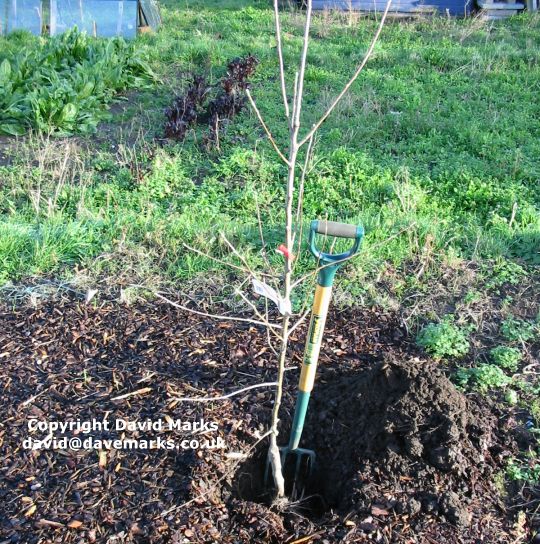 To apply organic mulches simply spread them over the soil to a
depth of about 5cm (2in). Make sure the mulch is not touching the
stems of any plants or trees.
To apply organic mulches simply spread them over the soil to a
depth of about 5cm (2in). Make sure the mulch is not touching the
stems of any plants or trees.
Name: jim@GardenAction
E-mail: webmaster@gardenaction.co.uk
Date posted: November 10, 2011 - 04:15 pm
Message: Old carpet works well! You can try straw, black polythene and cardboard.
Name: Traviss Locke
E-mail: travisslocke@gmail.com
Date posted: November 10, 2011 - 12:02 pm
Message: I have managed to clear most weeds and grass off my allotment. I would like to cover it for the winter to stop weeds growing back. What materials are best and where can I find them?