Categories
Calendars
Guides
Reviews
Archive
Gallery
Articles
Ask Our Gardening Expert
Sweet Corn - All You Need To Know (continued - page 3)
Cook sweet corn as soon as possible after picking to keep that sweet taste.
Remove the foliage, and cook for 7 minutes in boiling water. Sweet corn can also
be cooked on the barbeque - cover the cob in foil and put it on the barbeque
grill for 10 minutes or so. It is safe to put all sweet corn foliage on the compost
heap, although after eating, the remaining part of the cob will
compost much more easily if cut into several parts.
Pests and Diseases Which Variety CLICK
HERE FOR NEXT SWEET CORN PAGE CLICK
HERE FOR PREVIOUS SWEET CORN PAGE 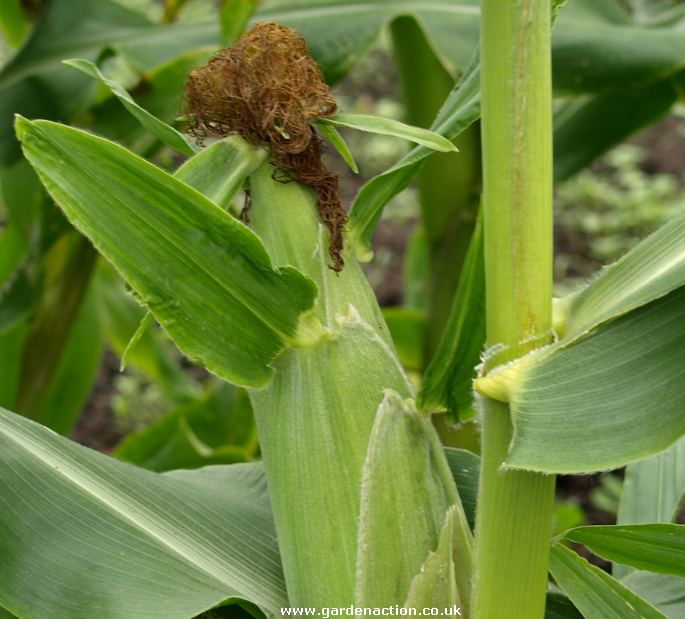 The sweet corn can be tested for ripeness by pressing a
kernel with your fingernail - if they are ripe, this will show a
creamy coloured liquid from inside the kernel. If the liquid is
watery, the sweet corn needs more time to ripen; if the liquid
is almost like dough, the sweet corn is over-ripe. Start this
testing when the silks (long silky threads which grow out of the
cobs) turn brown and start to shrivel.
The sweet corn can be tested for ripeness by pressing a
kernel with your fingernail - if they are ripe, this will show a
creamy coloured liquid from inside the kernel. If the liquid is
watery, the sweet corn needs more time to ripen; if the liquid
is almost like dough, the sweet corn is over-ripe. Start this
testing when the silks (long silky threads which grow out of the
cobs) turn brown and start to shrivel.
Garden fresh sweet corn has an amazing flavour. Freshly picked and then
barbecued preserves that taste best.
Click here
for our barbecued sweet corn recipe with full instructions and lots of step by
step pictures.
Sweet corn are remarkably free from pests and diseases, and you
are unlikely to have any problems in this area. The most likely
disease is 'Smut', though in the cooler climates it is rare. Smut is
a fungal disease, identified by green or white growths on any
part of the plant. There is no cure.
Sweet corn comes in three varieties - early, middle and late.
Forget the late varieties in the cooler climates. In the less sunny
areas of the UK, stick to the early varieties, sunny areas
should be safe with both early and middle varieties.
Click
through to the next page for a table of recommended varieties.
Name: Sheila
E-mail: Private
Date posted: September 06, 2011 - 03:16 pm
Message: As a new to growing sweetcorn,may have planted to late masses of sweetcorn,but now we are in September is there anyway I may harvest and rippen artifially?
Name: Mr Richard Leese
E-mail: richard.leese@talktalk.net
Date posted: August 22, 2011 - 06:23 am
Message: Name: Mr Richard Leese
E-mail: richard.leese@talktalk.net
Date posted: August 22, 2011 - 05:58 am
Message: Sweet corn are remarkably free from pests? However,I have problem with BADGERS eating some of them, under the POLYTUNEL Over night.This Information came fom my VET, THERE ARE BADGER SETS IN THE AREA
PS. If my Collie dog cannot get out how can BADGERS get in to the garden?
Name: Mr Richard Leese
E-mail: richard.leese@talktalk.net
Date posted: August 22, 2011 - 05:58 am
Message: Sweet corn are remarkably free from pests? However,I have problem with BADGERS eating some of them, under the POLYTUNEL Over night.This Information came fom my VET, THERE ARE BADGER SETS IN THE AREA
Name: Cherilynn
E-mail: admin@raahbar.com
Date posted: August 07, 2011 - 07:32 pm
Message: You have shed a ray of sunhsnie into the forum. Thanks!
Name: Jacqui gs
E-mail: Private
Date posted: July 13, 2011 - 10:15 am
Message: I grow sweetcorn last year for the first time, when it was ready to be picked there were lots of ear wigs on the cobs, any ideas how to prevent this this year /
Name: jason
E-mail: jsheppard70@optusnet.com.au
Date posted: October 09, 2010 - 04:33 am
Message: i am trying to grow sweet cornin my garden it has been a month and have only grown 4 inches.thay seem to have one long root and the leaves are starting to look shreded is it the soil or a pest..what do i do can someone reply
Name: Tim Steward MBE
E-mail: Private
Date posted: October 09, 2010 - 04:20 am
Message: I too have successfully grown some sweet corn for the first time this year. I was a bit late getting it in the ground however. This hasn't been a problem due to the very mild/hot summer. I have mostly three cobs to each plant and my wife says she has never tasted sweetcorn so fresh and delicious. Will certainally dosome more next year. The articles on this website are really very good. Thank you
Name: Orant Dyght
E-mail: dyghtorant@yahoo.co.uk
Date posted: October 01, 2010 - 07:43 am
Message: I started growing sweetcorn last year,which gave me great pleasure. This year i got some seed from angola i planted them in mid april and only in the last month that they are flowering and sending out the young corn shoots,but what is so fascinating one tree got up to five growth on it others have three and four on each stalk. IS THAT NORMAL OR UNSUAL? I WOULD LOVE A REPLY.