Categories
Calendars
Guides
Reviews
Archive
Gallery
Articles
Ask Our Gardening Expert
Growing Carrots
Looking
After Carrots Don't feed carrots, this will only
encourage the greenery at the expense of the carrot growth. If
your soil is sandy it needs improvement with well-rotted compost
or other humus material. The reason is that carrots like water and
sandy soil does not hold water. Early carrots do better on sandy
soil compared to maincrop varieties. The reason is that they have
to tolerate less of the dry weather. Thinning out the seedlings will release the scent of carrots, and attract
the attentions of carrot fly. To avoid this, perform this
activity in the evening when the carrot fly is not about. Ensure
that any soil disturbed by the thinning process is firmed back
down with your hand - carrot fly lay their eggs in loose soil
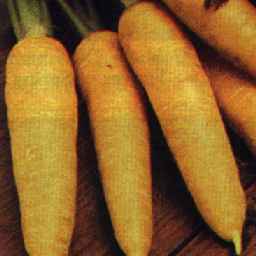
around the carrot seedlings. Harvesting Carrots Right
- Yellowstone Carrots harvested before maturity will be tender and more tasty than
those left in the ground longer - pull a few up and experiment
to see what suits you. Name: kasun Name: Sam smith
The normal cultivation rules apply to carrots - water when the
weather is dry, weed as required. Thinning out (removing some
seedlings to avoid over-crowding) should begin when the
seedlings are about 2.5cm (1inch) high. Thin the maincrop carrot
seedlings to 20cm (8in) apart, early variety carrots to 13cm
(5in) apart.
 When
the foliage begins to wilt and shrivel up, the carrots have
reached maturity. Use a fork to get the roots up, driving it in
a few inches to one side of the row, using it as lever to loosen
the roots' grip on the soil. The carrots can then be removed by
hand. If the weather is particularly dry, water the previous
evening to avoid damage to the carrots.
When
the foliage begins to wilt and shrivel up, the carrots have
reached maturity. Use a fork to get the roots up, driving it in
a few inches to one side of the row, using it as lever to loosen
the roots' grip on the soil. The carrots can then be removed by
hand. If the weather is particularly dry, water the previous
evening to avoid damage to the carrots.
Yellow and tasty
E-mail: kasun_abbo@yahoo.com
Date posted: September 16, 2011 - 02:10 pm
Message: send me about carrot diseases
E-mail: Private
Date posted: June 14, 2011 - 05:01 am
Message: thanks I'm going to Canington college and the info on carrots and other plants will be realy helpful in the work I'm going to do so thanks.
sincerly
Sam smith