Categories
Calendars
Guides
Reviews
Archive
Gallery
Articles
Ask Our Gardening Expert
How To Grow Mint Herb
Mint
MINT QUICK GUIDE Mint Folklore Latin Name Type Site and Soil Plant to Harvest Time Their problem is that they grow too well! If
left to their own devices, they will rapidly take over your
garden. Mints were used by the Greeks and Romans both for flavouring food and
as a medicine. Click folklore (right) for some of the myths surrounding mint. They can be harvested for at least six months of the year when grown
outside, and are superb when used to flavour meats (lamb is best known),
vegetables (especially new potatoes and peas), salads, tea and jellies.
Mint
is very tolerant of almost all conditions, but like all plants it will
grow best in certain conditions. The soil should be well-dug, fertile
and water-retentive, but not water-logged.
Whilst mint will grow well in
full sun, it does not like dry conditions. Its preference is therefore
for partial shade, and it is well suited to a North facing wall Propagation Mint has shallow, creeping roots which can be broken off and placed either
directly in the ground or in pots containing potting compost. Because
mint is such a strong-growing plant, it can easily kill nearby plants.
The solution when planting outside is to sink a bottomless container,
such as an old bucket, in the ground and plant the mint in this area.
The roots might not be stopped 100%, but it will do the job. Another
alternative is to dig a hole to a depth of 30cm (1ft) and line it with
black plastic (pierced with small holes for drainage). The soil is then
replaced in the black plastic and the mint planted in that area.
Mulching the soil will go a long way to keeping mint happy - it will
achieve the all important job of keeping a moist root run which mint likes so much. A
twice yearly feeding with bonemeal will keep it even happier. Remove the
flowers by hand as soon as they appear because if left, they will reduce
the amount of leaves. There is very little else to do except enjoy it. Mint suffers from only one disease and that is rust - allow it to get a hold
and it will kill all your mint plants. There are chemical sprays for
rust, but they can often be only a part solution. The best method is to
examine each plant carefully for signs of rust (orange blobs generally
on the underside of the leaves) and remove any leaves affected - spray
as well with a chemical if you want. If this does not remove the
infection chop the plant down to ground level and burn it all - drastic,
but the only cure in the late stages of rust infection. Recommended Mint Varieties Spearmint Mentha spicata
- a traditional mint for mint sauces. A strong grower with
attractive dark green leaves. Alpine Mint Bush Prostanthera
cuneata - try something different, mint leaves with pure white
flowers, a herb with true beauty. Chocolate Mint - really does taste a bit like
mint chocolate!. A novelty worth a try?

How To Grow Mint Herb
There are nearly a thousand varieties of mint, but only six or
so are worth cultivating. They are easy to grow in both shade
and sun with an require very little maintenance needed.
Click here
Mentha spicata (garden / spearmint)
Mentha pulegium (Pennyroyal)~
Mentha pipperata (peppermint)
Edible flowering herb.
Most soils, partial shade or full sun.
3 months
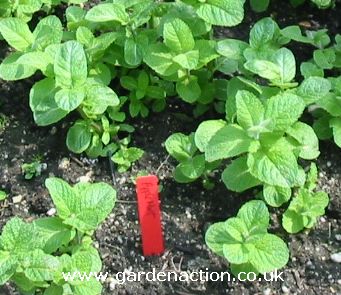
Mint is sold at most garden centres in small pots - as long as they are
purchased after all danger of frost has passed, they can be planted
straight outside.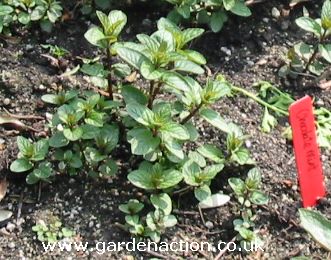
Choosing a variety of mint is a matter of personal taste. However, for
starters, shown below are a few tried and trusted varieties, all of
which can be bought online by clicking
(
).
Name: holly
E-mail:
Date posted: May 08, 2013 - 06:24 pm
Message: why are some of the bigger leaves on my spearmint plant turning black in spots??
Name: jim@GardenAction
E-mail: webmaster@gardenaction.co.uk
Date posted: October 23, 2011 - 04:30 am
Message: True, plant them in a bottomless bucket or a stout wooden container, otherwise you will be inundated.
Name: Patricia Kirkham
E-mail: shoeboxherbgardens@gmail.com
Date posted: October 22, 2011 - 11:32 pm
Message: It's a shame you say there are only about a half dozen mints worth cultivating. You mentioned Chocolate Mint which does indeed taste like chocolate-mint, most definitely worth trying! There are so many varities that are worth trying too. Have you ever tasted the freshness of Orange Mint, Lemon Mint, or Lime Mint? The standard Spearmint and Peppermint are great but there's also Apple Mint and Grapefruit Mint which aren't so great raw but when used for culinary dishes really come into their own! And what about Pineapple Mint and Corsican Mint? Both very lovely! Not to mention Banana Mint, Moroccan Mint, Lavender Mint, Ginger Mint... many types also have a varigated variety as well! There is truely a mint for virtualy every taste! But the one thing they all do have in common is that shallow, invasive root system.
Name: jim@GardenAction
E-mail: webmaster@gardenaction.co.uk
Date posted: October 20, 2011 - 02:56 pm
Message: Now you need to to find a way of getting rid of the agents
Name: Eil
E-mail: ebatterberry@hotmail.com
Date posted: October 20, 2011 - 09:58 am
Message: London UK
Hi, I just invented a way of containing my mint and getting rid of pesky estate agents' signs [realters to the colonials] in one swell foop. Dig as thin a trench as you can and bury them in the shape of the containment area you want leaving 3" (7.5cm) above ground. Better still; get your offspring to do it.
Name: Kat
E-mail: Private
Date posted: October 07, 2011 - 11:47 am
Message: Hi Vannie!
This might be too late, but it depends where you live really. If you live somewhere with a REAL winter, such as in the Midwest of America I'd say no. The frost, snow, lack of sunlight, and cold will pretty much do to mint what it does to every other plant in your garden.
However, if you live somewhere like California (like me) then sure thing. As long as you can give them full sun and plenty of water they will be happy to grow and grow.
Mint is easy to find at any garden store, such as Armstrong's or Home Depot.
Actually, if you want to grow mint in pots (like myself) you can grow them year round indoors (such as in a conservatory or near a large window with light). Just know that even if you start off with a small mint plant, the roots will quickly overtake the pot, so you'll probably want to just start off with a large pot. If not, the mint will get all leggy and not stay full, bushy, and beautiful.
Have fun!
Name: Vannie Ho
E-mail: Private
Date posted: September 09, 2011 - 08:35 pm
Message: Hi My name is Vannie as u can tell! I want to know can it grow during the winter times? And also..where can I get them? Like where can I buy them? Thanks!
Name: aarzoo
E-mail: aarzoo.madan@education.nsw.gov.au
Date posted: August 23, 2011 - 08:37 pm
Message: hello
meet your garden expert
Name: terri
E-mail: tcombs722@yahoo.com
Date posted: August 22, 2011 - 04:24 pm
Message: Question about mint plants... I have a healthy chocolate mint plant in a container(OMG! it really does smell and taste like choc-mint too!). I have brought cuttings into the house and put them in vases of water. After 5-7+ days, they drop these little black seed-like balls (no bigger than poppy seeds)? Are these seeds the plant is dropping? They are not on the bottom of the seaves when i bring them in, but I have seen them outside below the potted mint and on other mint plants too. They seem like too many to be bug droppings-plus I washed the stems and leaves when i cut them to bring in. Can you let me know what they might be? Thanks much-terri ~: )
Name: Jacqueline Cordova
E-mail: rchjcq@gmail.com
Date posted: August 01, 2011 - 09:57 pm
Message: My 10 year old mint plants were demolished, leaves eaten, webs at the base. It looks like Gypsy moth infestation, but I am in California. The eaten leaves happened quickly, and now there are lots of little moths flying around. I live in a forest at 5,200 feet. Any ideas?
Name: trev
E-mail: mr_raymond_burton@yahoo.co.ukc
Date posted: July 21, 2011 - 11:41 am
Message: Can I grow chocolate mind indoors,
Name: Pedro Vivas
E-mail: petervivasd@aol.com
Date posted: July 09, 2011 - 08:42 am
Message: There are white stains under the leaves adn the mint is dying. �How can I avoid it?
Name: shankar
E-mail: pradeepshankar007@gmail
Date posted: July 04, 2011 - 04:59 am
Message: How to cultivate mint for export sir ?
so please help me sir .
Name: samir
E-mail: sky595231
Date posted: July 04, 2011 - 04:45 am
Message: send me more emages aboat anythings please
Name: zoli
E-mail: Private
Date posted: June 24, 2011 - 07:52 pm
Message: I would like to grow plants for food because where I live wild mint grows and grows ... wild. Can you help advise me what plants would do great in that soil type and moisture condition. P.S. It's a natural spring where the mint grows, I am in southern california at 5,000 ft. Please help?
Name: Samantha
E-mail: Private
Date posted: May 04, 2011 - 10:32 am
Message: As a feild trip in highschool, we are creating a thrity foot in diameter, flower made entirrely out of flowers. I want to know How wide does mint get when grown??
Name: Jo
E-mail: Private
Date posted: October 04, 2010 - 10:22 am
Message: My mint is in full sunlight but watered and fed well. Recently, the stems have become dry and brittle and no new leaves are growing? Why do you think that is?
Name: ramadan
E-mail: Private
Date posted: September 28, 2010 - 11:36 am
Message: thank you for evrything
i am a farmer last summer i started growing mint but the area is about 1000 square metr i would like to have your advice on growing mint also i would like to know how to take care of my mint against any deseases or any other bad things which will effect my mint
Name: younus
E-mail: younus2010@yahoo.ca
Date posted: August 27, 2010 - 08:45 am
Message: my mint plant getting black spot on their leaves, what should I do ???