Categories
Calendars
Guides
Reviews
Archive
Gallery
Articles
Ask Our Gardening Expert
How To Prune Tomatoes in the UK
As far as pruning is concerned, tomatoes in the UK come in two forms, bush (or
determinate) and upright (indeterminate or cordon). The difference between the two types of
tomato plants is that bush varieties naturally produce a limited amount of side stems, they
"know" when to stop producing foliage and when to start producing tomatoes. For this reason
they need very little pruning. On the other hand, upright tomato varieties don't really know when to stop
producing and if left alone they will produce far too much foliage and too few tomato
fruits. Careful and frequent pruning will help them stop producing foliage at the correct
time and they will then produce a much better crop of edible tomatoes. Bush varieties do well for cultivation outdoors because they
require little pruning for most of the season. Remove any yellow or decaying
foliage as soon as possible to avoid the spread of disease. It's also a good idea to prune any stems that are touching or very near to
soil level. If left to touch the ground they may well catch soil borne diseases which then
go on to infect the whole plant.
If your bush tomatoes become too large to support themselves, either trim out a few
major branches or add more support canes - the side branches can then be
tied into the additional support canes.
Upright / cordon varieties are commonly cultivated in pots, grow-bags, the
greenhouse and sometimes outdoors in open soil. When
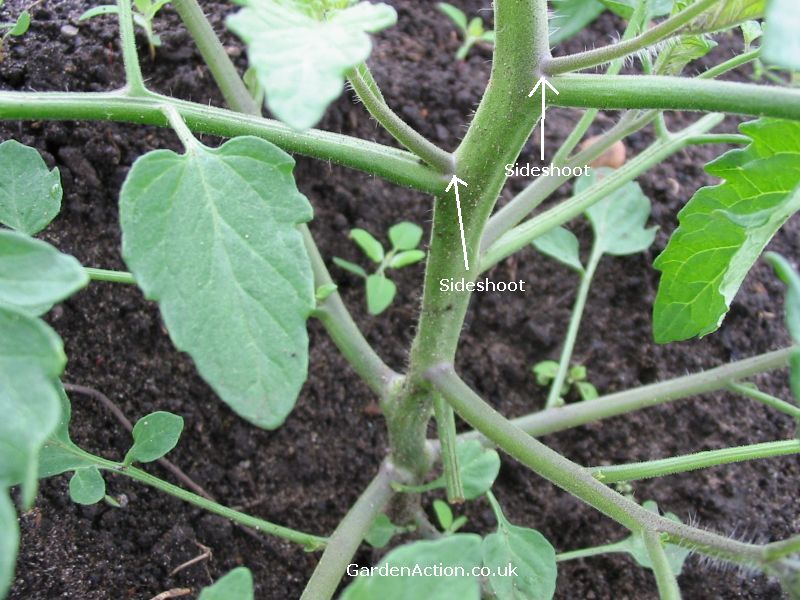
the first fruits begin to form, the plant will produce side-shoots in between the main stem and the leaf stems. These side shoots (see arrows in diagram on the right) should be removed by
pinching them
out with the fingers. If allowed to grow they will produce a mass of
foliage but few tomatoes. Any shoots which have been overlooked and
allowed to grow should also be removed (see X in diagram). If you click
the picture on the right, a real picture will appear identifying two
side shoots on a real tomato plant. Lower leaves which show any signs of yellowing should also be removed to avoid the risk of infection. When the plant has developed six or seven trusses of tomatoes (normally
around
July time), 'stop' the plant by breaking off the growing tip. If
any more than seven trusses of tomatoes begins to develop, pinch them
out to encourage the plant to produce good quality tomatoes rather than
an abundance of low quality late-maturing fruit. Pick as soon as the fruits are ripe (colour and size will identify this) for the best
flavour - eat as soon as possible. This also encourages the production
of more fruit. As soon as a frost threatens (around October in the UK), harvest all the fruit
immediately and ripen them on a window sill. With upright varieties, it
is possible to gently flatten the plants onto the soil and cover with
horticultural fleece to protect them from the frost.
CLICK
FOR NEXT PAGE ON TOMATO PEST & DISEASE

How To Prune Tomatoes in the UK
Pruning
Tomato Plants to
Shape
Limit the number of trusses of
tomatoes to seven or eight by pinching out any surplus ones.
When to
Harvest
Tomatoes
Tomato Home
Page
Name: val straub
E-mail: val.straub10@gmail.com
Date posted: October 03, 2011 - 07:04 pm
Message: Hi could you please give me some advice I have a truss tomato do you have to take the laterals out like a gross lisie thank you Val Straub
Name: julie
E-mail: laskey33@btinternet.com
Date posted: September 12, 2011 - 01:23 pm
Message: why haven't my tomatoes ripened? I have 4 large tomatoe plants and none of them are ripening!!
Name: eric
E-mail: pipeliner@live.co.uk
Date posted: June 20, 2011 - 01:50 pm
Message: im using natural fertiliser made from nettles and dandilions first time using this system seems very good up to now is there a down side to this method ?
Name: chris mcnamara
E-mail: pavend1@sky.com
Date posted: September 14, 2010 - 11:22 am
Message: Today, 4 of my toms ( floriano ) fell off the bush. I have picked all the others. How do I store them?
Name: Anne Marie Ferguson
E-mail: Private
Date posted: September 11, 2010 - 06:31 am
Message: I have 3 lovely tomatoe plants with over 30 tomatoes on them,the tomatoes are quite large. The only problem is that they are still very green and very firm,I have fed them.Will they ripen?