Categories
Calendars
Guides
Reviews
Archive
Gallery
Articles
Ask Our Gardening Expert
Growing Radish Plants
Care of Radishes Sometimes birds take a liking to to radish
seedlings, however once past the seedling stage, they leave them
alone. Harvesting
Radish Plant The larger winter radish plant takes about 3 to 4 months to mature, but
they have been bred to remain in good condition left in the soil for another three or four weeks past maturity. Alternatively,
they can be harvested, placed in sand and kept in a cool dark place for a month or so.
Pests
and Diseases of Radishes Flea Beetles showing as small holes in
the leaves. Click
here to go to GardenAction's page on Flea Beetles. Cabbage Root Fly showing as holes in the
roots. Click
here to go to GardenAction's page on Cabbage Root Fly. Radish Question and Answer Q. Why do my radishes not create a bulb?
A. Radishes will fail to bulb for several reasons. Possibly, they
are not properly thinned and are growing too close together.
Thin plants to a spacing of 2.5 cm (1 inch) apart when plants first
emerge. Radishes should be seeded two to three seeds per inch
and thinned when they are about 5cm (2 in) tall to a spacing
of one inch apart. Radishes will also not bulb properly when
forced to mature during temperatures above 28C (82F).
Q. Sometimes my radishes have a hot, bitter flavor. What is the problem?
A. Off-flavored radishes are caused by planting at the wrong time
or poor cultural practices such as low fertility or low moisture resulting in slow growth. For highest quality, radishes should
grow fast. Fast growth can be stimulated by adequate fertility and maintaining the soil in a good moisture condition. If
radishes are too old, they taste hot.
Q. What causes roots of radishes to crack?
A. This is usually caused by waiting too late to harvest the radishes.
Cracking is caused by fluctuations in moisture which cause the
root to swell rapidly and crack, especially near maturity.
Q. Are the leaves of radish plants edible?
A. Radish leaves are not poisonous and can be consumed although they have
a strong, bitter flavor. Many varieties also produce pods
when left past maturity - they look a bit like green chillis.
These also are edible, but are not to most people's taste.
Q. What are winter radishes and how do they differ from regular garden radishes?
A. Winter radish varieties produce large roots which may be round or
elongated and white, red or black. They require a long season for full growth. The roots may be eaten raw with vinegar or
cooked like turnips. The flavor of winter radishes is usually pungent and the texture move fibrous and less crisp than common
garden radishes.
Q. My radishes have a black, crusty growth around the globe - why?.
A. This is scab, a soil borne disease. It can be controlled by rotation within the garden to avoid planting in infected soil.
Growing Radish Plants
Your radish plants require almost no attention once past the seedling stage - their main
requirement is a reasonable supply of water. Do not apply any
additional fertiliser to summer or winter radishes, their needs are minimal.
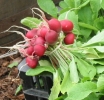 Summer
radishes should be harvested when they are crisp and young, normally about five weeks after sowing - consult the seed
packet. If they are left in the ground past maturity they will go peppery and the texture will quickly loose its crispness. If
you have too many at any one, give them to friends because they do not freeze well and will only last five days or so in the fridge.
Summer
radishes should be harvested when they are crisp and young, normally about five weeks after sowing - consult the seed
packet. If they are left in the ground past maturity they will go peppery and the texture will quickly loose its crispness. If
you have too many at any one, give them to friends because they do not freeze well and will only last five days or so in the fridge.
Radishes are by nature relatively trouble free, and because they mature so quickly, diseases do not have a chance to gain a foothold.
The two diseases which can affect them are:
Name: patty
E-mail: elf2638@tds.net
Date posted: June 11, 2011 - 07:02 pm
Message: why are my radishes with flowers on top of plants
Name: Dr T.D.Mishra.
E-mail: Private
Date posted: June 09, 2011 - 02:35 pm
Message: plz.Share with me your gardening experience!
Name: Nayyar Hashmey
E-mail: Private
Date posted: October 25, 2010 - 01:12 am
Message: I planted radish seeds in my backyard kitchen garden. I followed all instructions as provided by my seed supplier. However, its almost more than one month but I see only leaves. Bulbs are almost non existent. Just a string type root that's found under the laves. Can u plz guide wh t cud possibly be the reason/s.