Categories
Calendars
Guides
Reviews
Archive
Gallery
Articles
Ask Our Gardening Expert
Growing Chives in the UK (continued - page 2)
Chives
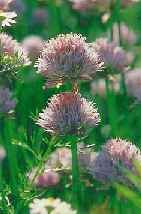
produce a mass of purple flowers in late Spring, and a second flush may
well occur between
June
to
July
. If you are growing the plants for eating only,
these flowers should be removed as soon as possible - if left, they
restrict the growth of new leaves. If the flowers are required for
eating or for their colour, it is best to keep separately a couple of
chive plants for this purpose. When the flowers are starting to fade,
cut the whole plant to 5cm (2in) from ground level and you will then
have a second set of leaves produced and probably a second flush of
flowers.
The
bulbs of chives are edible as mild onions, although we don't really recommend
this. The flowers are definitely edible and are great added to salads -
their colour makes salads come alive. The flower heads are actually a
mass of smaller flowers, which should be separated before adding to the
salad. The stalk is also edible, but is tasteless and very very tough -
throw it away! Container
Growing Varieties
of Chive There
are several new varieties of chives available from specialist seed
merchants and they aim to provide plants which produce very fine leaves,
much preferred by cooks. We have tried some of these and they do indeed
produce finer leaves, but only in the first year. The seeds are cheap,
so try a few varieties, but we do recommend the common chive for most
purposes. Chives
In Cooking Chives
can be used to add flavour to a huge range of food, probably best known
for adding to baked potatoes with butter. Other uses foods it goes well
with include mixed vegetables, egg dishes, salads and dressings, broiled
poultry, stews, casseroles and baked fish.
END OF CHIVES HERB ARTICLE
Growing
Chives in the UK
(continued - page 2)
Harvesting Chives
Cut the chive leaves with scissors when required, starting with the outside leaves
(those nearest the edge of the pot)
and working your way inwards. Always leave 5cm (2in) of leaves
remaining. The leaves rapidly grow back and can be cut several times in
the growing season. Plants grown from seed should be left alone
(although remove the emerging flower heads) until
July
in the first year
to allow a good root system to establish itself.
 This herb is ideally suited to container culture and will grow
happily in potting compost. Attention throughout the year is minimal.
Water if the compost is drying out, and feed with liquid plant food monthly throughout the growing
season.
This herb is ideally suited to container culture and will grow
happily in potting compost. Attention throughout the year is minimal.
Water if the compost is drying out, and feed with liquid plant food monthly throughout the growing
season.
Container grown plants are more likely to affected by severe
frosts, so move the containers close to the house walls in winter.
There are two main types of chive, common and Chinese or garlic (allium
tuberosum), both are cultivated in exactly the same way, although
Chinese chive grow slower. Chinese chives have an added subtle garlic
flavour to them and they are commonly used in Chinese cooking.
Chives should be used fresh and uncooked, otherwise they loose almost
all their flavour. When used with cooked foods, add them after cooking.
They can be dried, but their is little point because they then have no
flavour. One way to store them is to chop the leaves into 1cm (half
inch) lengths and place them in ice cue containers with some water.
Freeze them, and then defrost an ice cube or two when need to use
them.
Name: Decko Senn
E-mail: srimalisenn@aol.com
Date posted: October 25, 2011 - 11:43 am
Message: I am from Sri Lanka, I have been trying to grow chives, but it does not grow well after one or two months it becomes very thin. Can you advise me.
Name: janet
E-mail: janetkdemars@hotmail.com
Date posted: October 06, 2011 - 12:21 pm
Message: I've cut the flower stalks from my chive clump, are these stems used to dry and season with?
Thanks
Name: inese lewis
E-mail: quizby1925@hotmail.com
Date posted: September 01, 2011 - 10:53 pm
Message: I HAVE BEEN GROWING CHIVES IN CONTAINERS----PET BOTTLES -----FOR OVER THREE YEARS SUCCESSFULLY.The bottles are divided into two chambers-----water and soil.
Name: Dave
E-mail: dhookei36@aol.com
Date posted: May 18, 2011 - 07:51 pm
Message: Growing Chives
Name: Chris
E-mail: plantfrm@aol.com
Date posted: November 14, 2010 - 11:03 am
Message: I'm looking for a Chive plant with White Flower that Propagates fromthe roots not primariy from the flower.
Thanx for your time