Categories
Calendars
Guides
Reviews
Archive
Gallery
Articles
Ask Our Gardening Expert
How to Grow Parsley
Once growing well in a good soil, it is however a low maintenance
plant. It's leaves are attractive, it can be used both as an
attractive garnish and a flavouring for many foods - there are
not many people who turn their noses up at a fresh sprig or two
of parsley topping a boiled cod steak! Parsley especially amongst herbs, can be appreciated at it's most
flavoursome when picked fresh from your garden.
The only equipment you need is a large plastic pot.
Cut out the base of the pot to leave it as shown in the
picture on the right. The size of the pot is not crucial
but it must be big enough to allow the tomato plant to
be contained with it.
HOW TO GROW PARSLEY Parsley Folklore Latin Name Type Site and Soil Plant to Harvest Time
Where To Grow Parsley Propagating Parsley Parsley is often very slow to germinate because it needs high
temperatures. For this reason GardenAction always recommends that the
seed is sown in pots and kept indoors in a warm room until the seedlings have sprouted. In
March
, sow
four or five seeds to the pot, and if you are lucky for most of them to
germinate, thin out to one seedling per pot. Prepare the soil outside by
digging it well, and incorporating as much organic matter as possible.
Add bonemeal to the top layer of soil. The seedlings can be
planted outside when they are about 8cm (3in) high. Care of Parsley Parsley does not usually suffer from pests and disease. Occasionally, carrot or
greenfly attack them - spray with derris (available at almost all garden
centres) as a preventative measure in
June
and
August
. Container
Growing Parsley
Parsley
Possibly the most popular herb grown in cooler areas, but also one of
the most 'failed' herbs. There are two reasons for this -
firstly parsley is not so quick or easy to germinate as many
other herbs. Secondly, it does require a reasonably rich soil to perform well.
QUICK GUIDE
Click here
Petroselinum crispum
Biennial edible herb
Soil with organic matter, sun or partial shade
Three months
Parsley needs a rich well dug soil which does not dry out too often.
It prefers full sun, but if the soil is good, it will do very well in partial shade.
 The
two common varieties are curled-leaf and flat-leaf, although a wide
range is available from specialist seed companies. All varieties are
treated the same.
The
two common varieties are curled-leaf and flat-leaf, although a wide
range is available from specialist seed companies. All varieties are
treated the same.
A once monthly dose of general fertiliser will
keep the plants healthy. 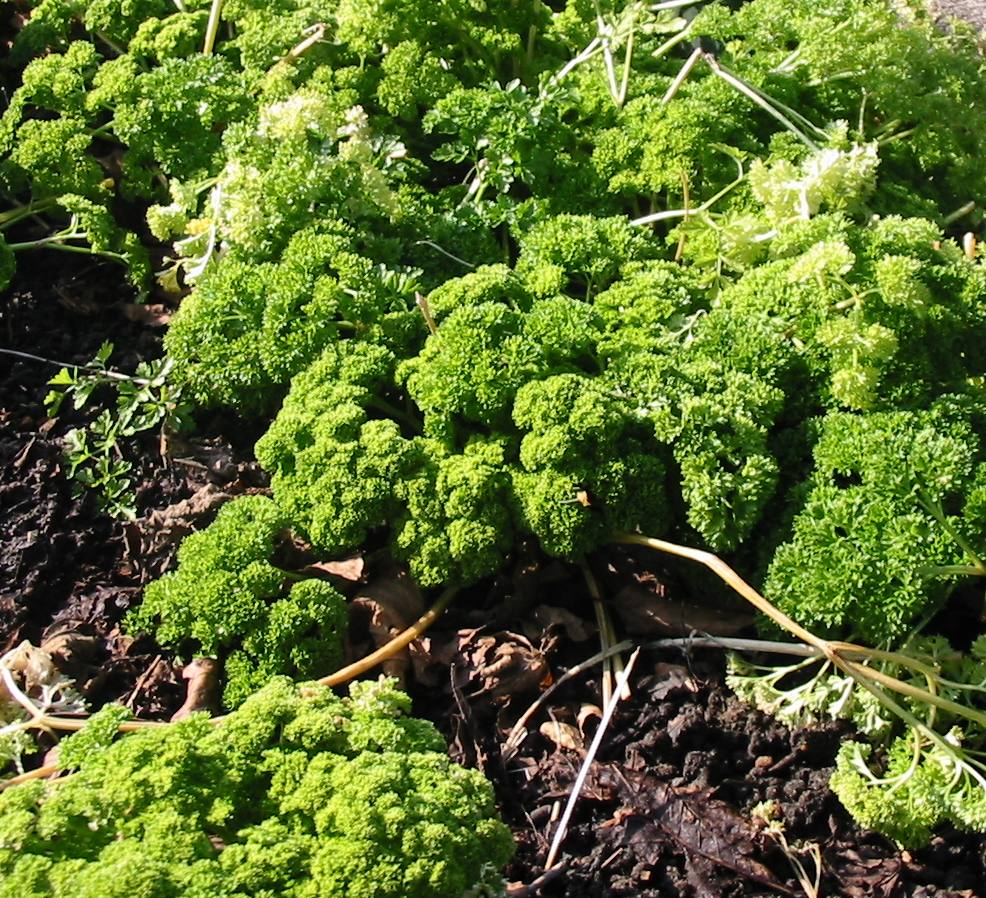 Parsley
sown in
March
can normally be harvested from
July
to
July
the
following year. Because it is a biennial, it will then begin to produce
seed which ends the plants use as a herb. Sowing later than
March
is
fine, the plants will mature later, and this will extend the harvesting time.
Parsley
sown in
March
can normally be harvested from
July
to
July
the
following year. Because it is a biennial, it will then begin to produce
seed which ends the plants use as a herb. Sowing later than
March
is
fine, the plants will mature later, and this will extend the harvesting time.
Parsley is an excellent plant for growing in all sorts of containers
- some very attractive pots are made especially for growing parsley. No
special care is required - just keep them in a sunny spot, feed
regularly with a liquid plant food, and ensure the pot compost is kept moist.