Categories
Calendars
Guides
Reviews
Archive
Gallery
Articles
Ask Our Gardening Expert
Grow Runner Beans From Seed(continued - page 2)
How To Sow Runner Beans Seed
Prepare the bed in March to allow the soil time to settle before planting. Do this by thoroughly digging to a spade and a half's depth, incorporating as much organic material as possible. Add a couple of handfuls of bonemeal per square metre (yard). The aim is to produce a soil which is as water retentive as possible to a good depth.
Sow the runner bean seeds a week before the last frost date ( late April ).Use a trowel to dig out a shallow drill 5cm (2in) deep. Where more than one row is being planted, each row should be 1.5m (5ft) apart. Runner bean seeds have a high germination rate of 85%, and for this reason should be sown thinly, one seed every 15cm (6in), to be thinned out to a final spacing of one seedling every 30cm (1ft) about 3 weeks after sowing.

To be doubly sure, sow several seeds at the end of the row for filling in any spaces where the seed has failed to come up in the row. After sowing, water the bed well if conditions are at all dry.
A good tip for extending the cropping season of runner beans is to sow half the seeds indoors or in a greenhouse. When you come to sowing time, sow the seeds as normal on one side of the row and plant the indoor reared plants on the other (see picture on right). The indoor grown plants will crop first, followed by those sown directly in the ground a couple of weeks later.
Do not soak the runner bean seeds prior to sowing in attempt to encourage germination. Runner beans have a high germination rate, so do not need this assistance. Worse, soaking the beans will encourage Halo Blight (see section on pests and diseases later on). Examine the beans as you sow them, and reject any which are wrinkled, disfigured or have yellow spots on them.
Runner Beans Seed - Getting An Early Start
Runner Beans can be given a head start (about four weeks) by sowing them inside and / or under cloches - click here for more detailed information. Simply place the poly-tunnel in position two weeks before sowing (to warm up the soil), then sow the seed three or four weeks earlier than normal. Click here to buy a poly-tunnel or cloche from GardenAction's preferred online supplier.
Supporting Runner Beans
 Runner beans grow to about 1.8m (6 foot) high and they
definitely need support. The idea is to provide a structure
which their tendrils can grow round and pull the plant up.
Runner beans grow to about 1.8m (6 foot) high and they
definitely need support. The idea is to provide a structure
which their tendrils can grow round and pull the plant up.
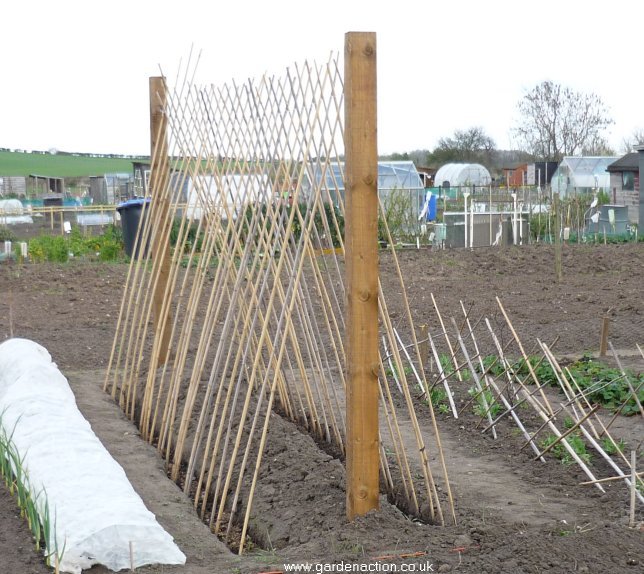
The most attractive form of support is a wigwam - four or five bamboo canes tied together at the top will be sufficient. The growth at the top will be a bit crowded, but this structure will still produce a good crop of beans.
Two poles tied at the top
erect a row like this with each pair joined to the next with nylon twine.
It is a good idea to twist some gardening twine round the bamboo canes, this will give the growing plants more to grab hold of.
Where space is really short, this type of structure can be used for container growing runner beans. In this case, insert one cane centrally in the container, tie six or so lengths of garden twine to the top of the cane and secure the other ends of the twine to the edge of the container. Plant three or four seeds, which will then grow up the twine. The plants will need their tips pinching out when they reach the top of the twine.
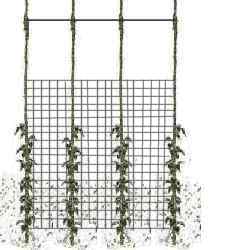
A single row of canes with plastic mesh

Wigwam support
Row of canes support
Other methods are to erect a criss-cross of canes, each pair tied together at the top, or simply a line of canes connected together with mesh netting. Both are illustrated in the diagrams below. Finally, don't forget that runner beans can be be grown up an existing fence which has been covered with mesh netting.
CLICK
HERE FOR NEXT RUNNER BEAN PAGE
RUNNER BEAN HOME PAGE
Name: jawahar
E-mail: Private
Date posted: October 10, 2011 - 11:39 am
Message: Very eager to look for advices.
Regards.
Jawahar.
Name: Anjii
E-mail: mmocurrencies@gmail.com
Date posted: August 08, 2011 - 07:24 am
Message: This is eaxlcty what I was looking for. Thanks for writing!
Name: Lana Gibson
E-mail: lana_gibson@bathnes.gov.uk
Date posted: August 07, 2011 - 11:36 am
Message: why do some of my runner beans go purple?
I have loads of perfectly green looking beans
Name: katrina
E-mail: katrina-45@hotmail.com
Date posted: July 28, 2011 - 07:08 am
Message: first time i have grown runner beans, can you help, lots of flowers are dropping off before the runner bean starts to grow
Name: kenny
E-mail: kenny.morris3@btinternet.com
Date posted: July 22, 2011 - 07:27 am
Message: first time grower of runners.i have lots of leaves but no red flowers. what can i do to help.
Name: Anon
E-mail: Private
Date posted: January 10, 2011 - 09:32 pm
Message: A tip I would like to share and that can save many hours in the garden is to buy all your veggies from Tesco.
Name: Colin Perks
E-mail: Private
Date posted: September 13, 2010 - 02:48 pm
Message: How do I stop my runner bean seeds from drying out and going wrinkly once they have been extracted from their pods I would like to keep some to re plant next year. Thank you.
Name: LINDA YOUNG
E-mail: linasweet1@live.co.uk
Date posted: August 22, 2010 - 07:33 am
Message: what can i protect my runner beans with so they dont get eaten