The premier gardening information source
Pears
PEAR TREE Latin Name Type Site and Soil Plant to Harvest Time How Many?
Pears are so bland in the shops because they are all the same
couple of varieties. Chosen so that they travel well, these are
not the delicious pears you can grow in your garden. We explain
how to plant, prune, care and harvest from your garden. We do it
step by step in easy to understand language.
QUICK GUIDE
Pyrus communis
Hardy deciduous tree
They prefer full sun and in a
protected position. Avoid very alkaline soils.
A 2 year pear tree will produce fruit 3 years after planting
Bush trees 25kg (60lb). Dwarf
trees 7kg (15lb).
CHOOSING A PEAR TREE
Pear trees bear fruit for anywhere between 60 and 200
years so give some careful consideration to the variety of pear
tree you choose to grow. The factors involved in choosing a pear tree are size
(controlled by the rootstock), taste and size (the variety) and
pollination. Each is discussed in detail below.
First decide how big you want your tree to grow. The eventual size of a pear tree depends on the rootstock. Pears are "grafted" onto rootstock. This means that the lower trunk of the tree is from a different tree to that of the top part of the tree. The reason this is done is because a pear tree grown on its own trunk and roots would be too large for most gardens. The fruit would certainly be out of reach without a ladder.
There are two commonly available rootstocks, Quince A and Quince C. There are minor differences between the two but nothing hugely significant.
QUINCE A is the most common and will enable you to grow a pear tree at maturity somewhere between 3m to 6m (9ft to 19ft). Regular pruning can keep the tree to size you want within that range. Very fertile soils will produce larger and quicker growing trees compared to less fertile soils. Fruit will appear after 5 years.
QUINCE C is less common but still readily available. At maturity the tree will be 3m to 5m (9ft to 16ft), not a great size difference compared to Quince A. Pear trees on Quince C are slightly quicker to produce fruit but the difference will only be one year. Much depends on the pear tree variety. In general, fruit will appear after 4 to 5 years.
This is a matter of personal taste but here are a few pointers. Factors to be considered include the site where the pear tree is to be grown. Some varieties tolerate colder and windy conditions better than others. Disease resistance varies considerably between different varieties.
As for taste, some pears taste better than others or are juicier. All these factors need to be considered when growing a pear tree. Hopefully the table below will help you in that choice. Although the pollination group for each variety is shown below, going to the next page will show you an easy to understand table of compatible pollinators.
CLICK ANY VARIETY NAME BELOW FOR A PICTURE
VARIETY
NOTES
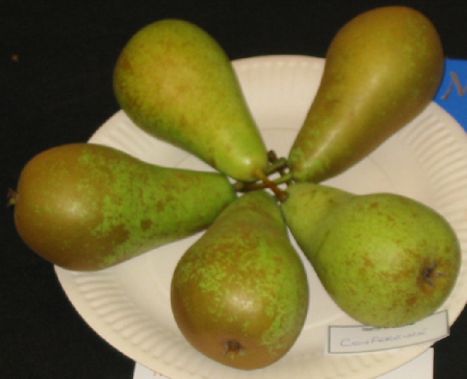
Conference
The most commonly grown pear
because it withstands unfavourable conditions best. Good
disease resistance but watch out for scab. Conference is
partially self-fertile but will crop better if other pear
trees are nearby. Pollination group 3.
Blossom is produced in mid-season, the pears are ready for
picking towards end September. Keep the fruit for one
week at least before eating. They should last for 3 to 4 weeks
in good storage conditions.
Doyenne Du
Comice
Judged by many to have the
best texture and taste of all the pear trees. The fruit is
really juicy. This pear is a bit temperamental and appreciates
a protected and warm position. Pollination group 4. Scab is a big problem
with this variety. Blossom appears late in the season. Fruit
is ready for picking in October and the fruit will keep for 2
weeks.
William's Bon Chretien A well known pear variety that stands cold better than most other varieties. A regular cropper which flowers mid-season. Very prone to pear scab. Pollination group 3. The fruits are ready for harvest in mid September, they should be eaten immediately.
Beurre Hardy We recommend this variety, along with Beth below, it was given the RHS Award of Garden Merit in 1993. It tastes superb, the leaves turn red in autumn and it is has some resistance to scab. Needs other pears in pollination group 3. Pick the pears in end August, store for two to three weeks and they will ready for eating.
Beth RHS Award of Garden Merit in 1993. This pear tree was released onto the market in 1974 so is a relative new-comer. This pear is juicy and tasty with lovely white flesh. It is in pollination group 3 and needs other trees nearby in the same group. We recommend it highly.
Concorde This pear tree crops reliably each year and is tastes good. Grows slightly smaller than many trees so is ideal for small gardens or growing as a cordon. Pollination group 3 it can be picked in late October. This pear is self-fertile and can be planted on its own.
Improved
Fertility
A great pear
tree if there are no others nearby of the same pollination
group (group 4) because it is self-fertile. Does even better
if a pollinator is nearby. Good disease
resistance, it grows well even if conditions are cool and
gives a heavy crop. Pick in mid September. Leaves turn an
attractive red in autumn.
Louise Bonne
of Jersey
Another pear
tree that withstands cold better than most. It's a regular
cropper with stunning blossom. The fruit is juicy and tasty
and can be picked in late September. Pollination group 2.
Packham's Triumph A tip bearing pear tree which bears sweet and tasty pears in mid October. If you want to keep pears in storage for longer than normal then this is the one for you. Kept properly they will store for two months. Home grown pears in mid December are a possibility! Pollination group 2.
Name: jim@GardenAction
E-mail: webmaster@gardenaction.co.uk
Date posted: December 24, 2011 - 02:39 pm
Message: The rootstock is more vigorous than the fruiting wood and can take up a greater part of the tree's nutrients. You need to divert as much energy as possible to the fruiting wood. Remove the rootstock branches as a normal part of the pruning cycle. The best time is when the tree is dormant and seal the wounds.
Name: denis lynch
E-mail: denisjlynch@btinternet.com
Date posted: December 24, 2011 - 09:43 am
Message: I have a pear tree 3 metres trained against the south west side of a brick wall.
It produces 50 to 60 beautiful pears each year.
The root stock (which bears no fruit) is getting bigger than the fruit branches. Should I cut the rootstock branches back, by how much and when?
Any advice gratefully received.Thank you.
Name: Tougas
E-mail: mario_tougas@msn.com
Date posted: December 02, 2011 - 03:28 pm
Message: do you know if rootstock oldhome can tolerate cold like ussuriensis.
From Dunham Qu�bec.
Name: Lonnie Carlson
E-mail: glcar@lakedalelink.net
Date posted: October 03, 2011 - 01:43 pm
Message: I'm in zone 4 9 (MN), bought a home that has a pear tree in backyard. It has great pears at end of sept.-early oct.how do i know what kind it is and how can i get it to produce 12 pears. i'm not sure there's another pear tree around, but we've been there for four years and have had pears, just not too many.
Name: Louise
E-mail: louisem@plymouth.edu
Date posted: September 22, 2011 - 08:47 pm
Message: Just moved back to my former home. My 15 foot pear tree has a bounty of pears that are hard and deformed. There is no other pear tree on the property. Are the deformities a result of no other pear tree, lack of soil nutrients (we have sandy soil), years of neglect or all of the above?
Can this fruit be eaten or used in dessert plates?? Is it better to remove and replant?
Name: Jackie
E-mail: Private
Date posted: September 14, 2011 - 04:07 pm
Message: We have a pear tree but are unsure of the type. How do we find out what type it is? It has never produced any fruit and we've had it about 5 years. Any advice would be helpful. Thanks
Name: richard kellam
E-mail: rjkellam81@hotmail.co.uk
Date posted: September 03, 2011 - 11:58 am
Message: I have a fine mini orchard with good large hard pears but! when do I pick them? Advise please. Thank you
Name: Katie McLaird
E-mail: katie.mclaird@gmail.com
Date posted: August 09, 2011 - 05:42 am
Message: I have just moved into an old house which has several apple & pear trees. but what puzzles me is a couple of small bushes with fruit on I can't identify. It is thorny & has small plum size 'apple like' fruit, turning to a golden yellow colour now in early August. I cut open one of them & it has pips similar to an apple only white & has a very sharp apple taste, but I can't find it anywhere on the internet. could you give me some idea what it might be?
Name: Roly
E-mail: Private
Date posted: August 08, 2011 - 03:10 pm
Message: We purchased and planted a dwarf Conference pear tree alongside breaburn apple, victoria plum and merrillo cherry in in October 2009, the apple, Plum and cherry trees have all developed well but the pear tree is not much bigger than when planted and the leaves are still tiny, with the main trunk and branches are green in colour not a healthy brown. Could you please give me some ideas as to why and any help as to what to do about it.
Name: John Parker
E-mail: parkerj@parkerj.karoo.co.uk
Date posted: June 17, 2011 - 05:33 am
Message: I would like a quince c conference pear tree to train on a fence trellis.What size should I start with and what is the availability
Name: Arthur Marett
E-mail: arthurmarett@tiscali.co.uk
Date posted: May 05, 2011 - 12:48 pm
Message: WHY HAS MY CONFERRENCE PEAR TREE NOT SHOWN ANY BLOSSOM THIS YEAR OF WHICH IT IS ITS FIRST YEAR
Name: Eddie Boyes
E-mail: qe04@liv.ac.uk
Date posted: May 03, 2011 - 12:57 pm
Message: I've just had to take down an old Victorian pear tree as it was rotten and about to fall and kill someone in a high wind (already leaning after a strong wind). I want to replace it with something as close as possible. I assume it was a 'Williams'. Is it possible to get a 'Williams' that hasn't been grafted on to a rootstock (Quince A or B). As far as I can see, all the ones available have been grafted on to Quince.
Name: james spradlin
E-mail: csprad1@yahoo.com
Date posted: October 27, 2010 - 12:30 pm
Message: my pear tree is bearing fruit in october. what gives?
Name: carrie
E-mail: carolyn.mann5@virgin.net
Date posted: October 24, 2010 - 08:27 am
Message: I have a quince tree with an abundance of large fruit but when I cut into them they appear brown and bruised inside although there is no lesions or bruising on the skin surface. Can I still use these fruit to cook with or are they useless?
Name: tim rugg
E-mail: Private
Date posted: October 11, 2010 - 12:51 pm
Message: I have a conference pear tree in my garden that I would assume is quite old. Main trunk between 14-18 inches in diameter. I've been in my house about four years and hard pruned it about two years ago. The last two years I've had no fruit although lots of new growth and blossom in spring. The trouble is the leaves turn black (from the edges inwards) early on in the growing season and then the fruit all drops off systematically. Now it looks like a woodpecker has been having a go at the bark these last few months! Can I save the tree and get it looking healthy and fruiting again and is there any specific fertiliser I should be using? Many thanks "worried about losing my pear tree" of Isleworth, Middlesex.
Name: Roy Edwards
E-mail: janine.ed@videotron.ca
Date posted: September 29, 2010 - 08:15 pm
Message: Dear Sir,
I need to know what kind of desease my pears have. They are deformed and have hard spots with each deformed cavities. They told me when I bought it that it was a Hardy pear tree.Can you help me please.
Name: roger stockwell
E-mail: rogan@talktalk.net
Date posted: September 02, 2010 - 03:58 am
Message: I have a forgotten pear tree it is only 2 meters high has never been pruned and needs guidance do I cut off the bottom branches to encourage better fruit on the top it is laden with pears but they are not very big, also should I pick some of the pears to help the others on the same branch to grow as they seem to be compacted
Regards
Name: kevin
E-mail: kevin@denmylne.co.uk
Date posted: August 27, 2010 - 09:38 pm
Message: i live in lindores, newburgh, fife. I want to graft and grow some new lindorsii pear trees to distribute through out lindores and newburgh. there is only one living lindorsii pear tree left in lindores. I do, however, have some pictures of a lindores pear tree which blew down in 1879, during the same storm which brought down the 1st tay bridge. A "vastly huge" tree 66ft tall, 17.5 ft in circumfrence, with a spread of branches 53ft wide. people used to travel miles just to see this tree, the local photographer made postcards of it. I think it would be a crime to dwarf it using Quince A or C rootstock, which is the impression that your article above suggests.
Question, what rootstock would you suggest, that would not inhibit its growth. ??
Name: julie oaten
E-mail: juliejfy@aol.com
Date posted: August 21, 2010 - 11:59 am
Message: i have a williams pear tree but nothing does it bear i planted it three years ago
as a young from a garden centre , their has been no flowers in the spring or any thing it looks healthy do you no whats wrong.
Name: vicki
E-mail: vicki@yahoo.co.uk
Date posted: August 14, 2010 - 10:55 am
Message: I have a pair tree which was planted from a pip 12 years ago by my farther the last 3 years it has produced pears it looks like the concorde above and they are starting to fall off the tree but are really hard and not very juicy or tasty what should we do leave on the window to ripen what do you think vicki please let me know.