Blooming Flower Bulbs Indoors
When To Start
The majority of indoor flowering bulbs take 12 weeks from planting to flowering.
Decide if you want all the bulbs to flower at the same time or in
succession and plant them using the 12 week rule.
What To Plant

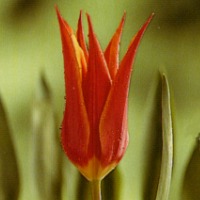
Tulip 'Alladin' |
Selecting
bulbs is easy - choose the largest, firm and healthy examples. In
the case of bulbs, size does matter, the larger the better (also more
expensive). Avoid examples which look unhealthy or are damaged.
The most widely available indoor bulbs are Hyacinth, daffodils (narcissi),
crocuses and tulips. Ensure the bulbs you purchase are specifically for
indoor cultivation. Others which are suitable include
snowdrops, iris, scillas, muscari and chionodoxas. |
Click here
for a list of recommended varieties (tulips, daffodils,
hyacinths and crocuses) which are recommended as indoor bulbs. Many have pictures.
How To Plant
Plant the bulbs
individually in plastic pots (or the final planting bowl) filled with
normal potting compost. Bulb fibre (more expensive than potting compost)
is only necessary where there are no drainage holes - the fibre helps to
keep the compost sweet. Whichever compost is used, it should be
moistened before planting the bulbs. The larger bulbs (hyacinths and
tulips) should be planted to half or three-quarters their depth,
smaller bulbs (crocuses and daffodils) should be planted with their tips
just below the compost surface.
All bulbs need to spend time in in cool dark conditions before flowering -
known as 'plunging'. This is necessary for a good root system to
develop. The best place for 'plunging' is the garage or garden shed.
Place the planted pots in a black polythene bag (pierced with a few
holes) and leave them where they will not be disturbed.
Check the plants each fortnight, watering a little if the compost has dried
out. When plants have sprouted one or two inches, they are ready to be
brought indoors. For 'prepared' bulbs (consult the packet), this will
take approximately 6 weeks, for other bulbs, it will take roughly 9
weeks.
Where the bulbs have been planted individually, transfer them to the final
planting pot, choosing bulbs which have developed to the same stage.
Traditionally, bulbs are planted in shallow containers, but this is not necessary
as long as the bulbs are at the correct depth (as described
above). Place the bulbs in the container as close together as possible,
without actually touching, for maximum effect. Place them in the coolest
room in the house.
Alternative Planting Ideas
A great idea to keep the kids (and adults) amused is to plant hyacinth bulbs in
glass or plastic containers filled with water. The bulb base should
barely touch the water. As the plants grow, the roots will descend into
the water and the foliage and flowers will develop as normal - great
fun. Special containers can be brought for this purpose, but any glass /
plastic container of the correct size will do. Remember that the bulb
and container should be kept in the dark and cool initially, as
described above. For this reason, it's best to select 'prepared' bulbs
which will reach the sprouting stage much earlier than non-prepared
bulbs.
After Flowering
After flowering, all bulbs (excluding 'prepared' bulbs) can be planted outside for outside flowering next year.
CLICK HERE FOR NEXT
PAGE
|