Categories
Calendars
Guides
Reviews
Archive
Gallery
Articles
Ask Our Gardening Expert
Camellias
Flower colours range from white through pink to deep reds. In garden settings, they form bushes 2-3m in height. They are well adapted to acid soils, rich in humus but do not tolerate alkaline, poorly drained soils. Most species are hybrids and only need protection in hard winters. Camellias grow best in sheltered positions, in light shade where they get only morning sun. If the site is too sunny, the flowers drop prematurely and if too shady, growth is lank. They are available in a several flower forms, single, double, rose, anemone and peony types.
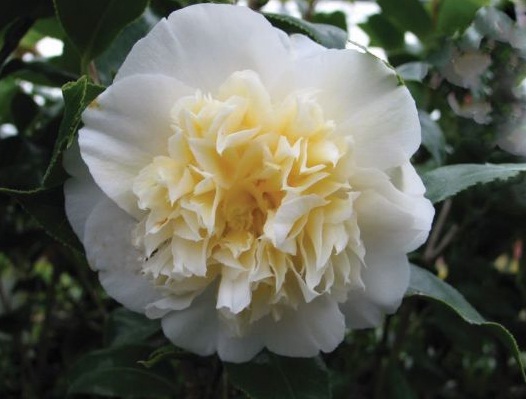
A camellia described as having a compact habit bearing antique white anemone form blooms with primrose lemon petaloids.
When planting, a hole much larger than the root ball should be dug, the soil mixed with bonemeal and composted material before back filling. Plant to the same level as the container or to the soil line on the trunk. Water the plant in well, the soil mulch the soil and feed after flowering.
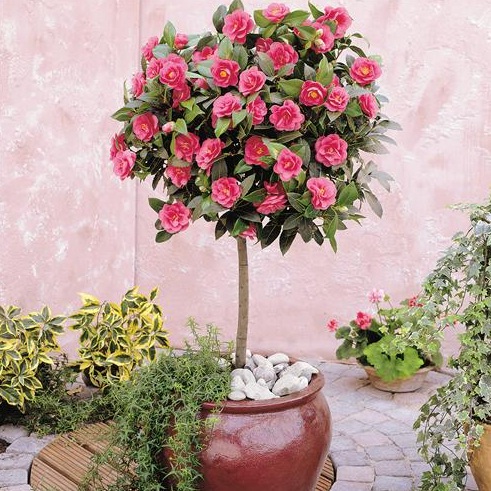
A standard container grown camellia
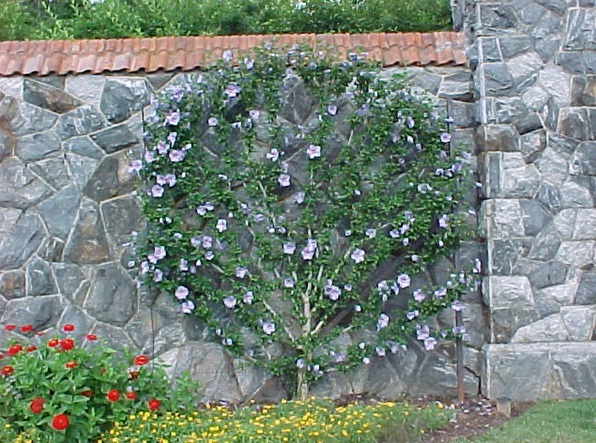
Camellias are good subjects for training. Standards can be formed from a straight stemmed, young plant. The lower foliage and side shoots are removed, the stem is staked and when the plant reaches the desired height, the terminal bud is removed to encourage the branching that forms the head. A selected cultivar can also be grafted on to a vigorous, standard trunk. Espaliers take more time and can be grown by training thin, pliable shoots on to a horizontal support. Camellias can make effective hedges by close clipping and can withstand frequent trimming.
An espaliered camellia
Most camellias propagate well from semi-ripe cuttings. Some bottom heat will help.
Camellias are natives of eastern and southern Asia. Camellia sinensis is the plant from which tea is made, though most varieties are grown for their flowers. In their natural state, they form evergreen small trees up to 20m tall and grow on forest slopes.