Categories
Calendars
Guides
Reviews
Archive
Gallery
Articles
Ask Our Gardening Expert
How to Propagate roses with pictures and advice.
PROPAGATING ROSES Some modern roses, Hybrid Teas mainly, are not sufficiently vigorous to propagate by cuttings -
only the stronger growing varieties such as 'Iceberg' and 'Peace' are
amongst those which are suitable. In general terms, floribundas, climbers, ramblers and
shrub roses are very likely to succeed from cuttings, most Hybrid Tea roses are likely to
fail from cuttings.
This is the time when your rose has the most potential for producing roots from hardwood cuttings.
The first step is to select a stem from the rose. Look for a healthy
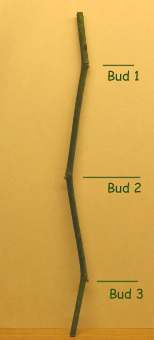
stem about 30cm (1ft) long from near the base of the plant. The stem should include at least three buds (see picture on left).
Stems should have been produced from early in the year (i.e.
they are fully mature). If immature stems are selected (i.e.
those produced later in the year), the cutting is liable to rot. Cut the stem from the plant using a sharp knife or secateurs.
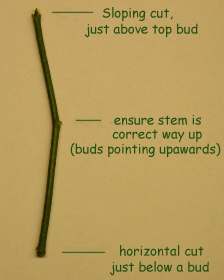
The next step is to correctly trim cutting. Firstly, ensure that you
are holding the cutting the correct way up! In other words
ensure that the buds are pointing upwards. Make a sloping cut
just above the selected top bud. Make a horizontal cut juts
below the selected bottom bud. In the picture to the right, this gives us three buds (top middle and
bottom), with a length of about 15 cm (6 inches). Rooting compound can be applied to the base of the
rose cutting, although
with hardwood cuttings this is not really necessary.
Finally, choose a small patch of soil in your
garden which is not over-exposed to the
winter weather (near a wall or hedge is ideal), then dig it over
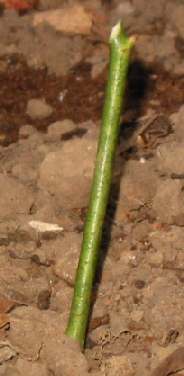
with a trowel. Simply push the cutting into the earth about half or two thirds down and gently firm the soil down around the
cutting. Note the the name of your rose garden plant on a marker tag and insert that next to cutting. The picture on the left shows only one rose cutting, however several can be
inserted near another, just ensure they are not touching. The rose cuttings should remain undisturbed until next
autumn, by which time they
should have rooted sufficiently well for them to be transplanted to their final
position in your garden.

How To Propagate Roses
Commercially almost all roses are propagated by budding. This takes a
large degree of skill and involves buying rootstocks. For this reason
most amateur gardeners who propagate roses, do so by using cuttings.
This is the easiest way to propagate plants for you own rose garden at little cost.
Name: Maria
E-mail: Private
Date posted: September 29, 2011 - 11:37 pm
Message: none
Name: Elspeth Farrar
E-mail: Private
Date posted: November 02, 2010 - 05:46 pm
Message: Please can you identify a lovely little 'garnet' rose with a beautiful small bud, a bout the size of C�cile Brunner, but more salmon pink than pink; light green foliage, prolific flowers continuously flowering till Dec. or so, and the buds opening to paler salmon pink as they blossom. The bush is about 5'-6'high, and about 5' across. It is at least 68 years old. It is much loved and admired and I want to get one like it, as we have to sell the family home. I will take cuttings but want to be sure of the name, and purchase a young plant too. Thank you, Ellie Farrar