Categories
Calendars
Guides
Reviews
Archive
Gallery
Articles
Ask Our Gardening Expert
How To Deal With Black Spot
Treating Black Spot can be much more effective when you understand the
life cycle of the disease. The disease starts in late Spring when Black Spot
spores, which have over-wintered in the soil, are blown or splashed by
rain onto the rose bush. When the weather warms up (especially if it is also
damp), the disease spreads throughout the plant. The
affected leaves die, fall onto the soil where they further
re-infect the rose. Leaves which fall in Autumn stay on the
soil, allowing the spores to over-winter in readiness to infect
the plants again next Spring. GO
TO THE GARDEN PEST AND DISEASE MAIN PAGE FOR The key to controlling Black Spot is to attack
it at two points in its life cycle. First when the infected
leaves fall to the ground and second in late Spring when spores
already within the plant begin to do their dastardly work. First attack - pick up and destroy all
leaves (infected or not) which are on the soil surface - try to
do this as often as possible. This will prevent re-infection
during the season and reduce the number of spores which
over-winter in the soil. Second, spray with a systemic fungicide such as
Rose Clear in late Spring and again two weeks later. Spray at
this time of year even though there may well be no sign of Black
Spot. This will attack the disease well before it has gained a
stronghold and is at its weakest. Further spraying should only
be necessary when signs of the disease are apparent later in the year. Another weapon against Black Spot is to grow
varieties which are naturally resistant to this disease. Ask
you nursery for advice.
How to Identify and Treat Black Spot
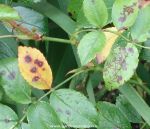
A very common disease especially with roses. Black Spot can be identified, as
the name suggests, by black or brown patches on the leaves. The
spots are irregular in shape and often join together. The leaves
turn yellow and fall off. If left untreated, it will strip the
plant of all leaves, and after two or three seasons, kill the rose.
PESTS AND DISEASES CLASSIFIED BY PLANT
Frequent turning over of the top 3 cm / 1 in of soil will help expose the spores to
the ravages of frost and will kill some.