Categories
Calendars
Guides
Reviews
Archive
Gallery
Articles
Ask Our Gardening Expert
Robinia Trees
Robinia is a genus of flowering trees belonging to the Fabaceae (Legumes) family, the same family as peas, beans and clovers. They are deciduous natives of North America and Mexico, commonly called ‘locust trees’, growing to heights between four and twenty five metres. The leaves are pinnate, with oval leaflets and the flowers are white or pink. Young branches may have sharp spines. Some varieties are sold as “wisteria trees” and their common name is “false acacia”. They have been naturalised in other temperate zones and sometimes form invasive suckers. Robinia tolerates pollution, so is an excellent subject for densely populated urban and industrial areas.
Robinia pseudoacacia ‘Frisia’ is a commonly planted variety growing up to 12 metres and has become very popular in the last thirty years. It has bright golden yellow leaves, its white flower clusters are present but not often seen in this form. Its blackish bark forms an excellent contrast with the leaves. The green leaved form has large numbers of pea like flowers that are followed by bean like pods. This species is poisonous so care should be taken when children are present.
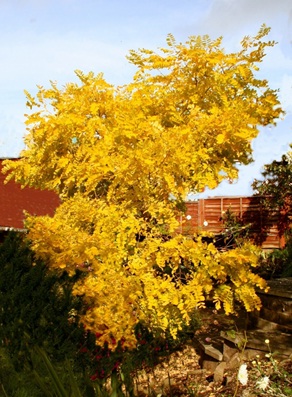
Robinia Frisia
A selected form of another species, Robinia hispada is often called the pink wisteria tree, growing long racemes of pink flowers and grows up to four metres. Another interesting, widely grown small form is ‘Mop Top’, which makes a good container specimen.
Robinias are easily grown in well drained soils but have brittle branches, easily damaged by wind. Selected forms and hybrids are usually budded or grafted.