Categories
Calendars
Guides
Reviews
Archive
Gallery
Articles
Ask Our Gardening Expert
How to Grow Peas (continued, page 2)
Prepare the soil in
December
to allow it
to settle. Dig to at least a spade's depth (the roots of peas
like to grow deeply), incorporating as much organic material as
possible. Peat (or peat substitute) is fine because peas 'fix'
nitrogen into their roots from the air and have little need for
a nitrogen rich soil. Add a handful of bonemeal (two if the soil
is poor) per square metre (yard), and incorporate it into the
top soil.
An
alternative to cloche protection is to sow the seeds in
late February
on a windowsill - if this is done, use peat pots (not plastic),
because the seedlings can then be planted directly into the soil
with the peat pot (the peat will quickly break down in the soil)
- peas do not like their roots being disturbed. Remember to harden off
the seedlings prior to planting permanently. Prepare a shallow drill using a trowel, and sow the seed 2.5cm (1in) deep -
where more than one row is being sown, the distance apart should equal
the eventual height of the plants. Sow the seeds singly at 5cm (2in)
intervals - the germination rate is high and over-crowding will affect
the health of the plants. One method of increasing the success rate is
to soak the pea seeds in water for 4 hours before planting. When
planted, water well if the conditions are at all dry. The seedlings
should appear in approximately 15 days time. Care
of Your Peas Yet another method, and the best one from our view is
to use wire netting. Plant two rows of peas and when they start to
come up , "cage" them with wire netting.
The cage is simply supported by four canes at the corners.
This method requires no tying in of the plants. And best of
all, at the same time as supporting them it protects them from
rabbits etc. The plants should be pinched out when they reach
the top to encourage shoots further down the plants. Where the
plants are grown against a fence, plastic netting can be secured
to the fence and the tendrils will cling to it pulling the plant
up. CLICK
HERE FOR NEXT PAGE ON PEAS CLICK
HERE FOR PREVIOUS PAGE ON PEAS Name: Vishal Chandran Name: Elizabeth Name: Gabrielle Name: Bob Name: Azad nahar  Peas can be sown outside with no protection in
March
.
If you want pea crops three or four weeks earlier, use a small
poly-tunnel or cloche. Simply place the poly-tunnel in position
two weeks before sowing (to warm up the soil), then sow the seed
three or four weeks earlier than normal.
Click here
to buy a poly-tunnel or cloche online from our recommended suppliers.
Peas can be sown outside with no protection in
March
.
If you want pea crops three or four weeks earlier, use a small
poly-tunnel or cloche. Simply place the poly-tunnel in position
two weeks before sowing (to warm up the soil), then sow the seed
three or four weeks earlier than normal.
Click here
to buy a poly-tunnel or cloche online from our recommended suppliers.
The first key need of peas is moisture, and they must be watered
throughout their lives when conditions become dry. If the soil has
been well-prepared (see
previous page) they will have no further need for feeding. A mulch
of organic material around the plants will help to keep weeds at bay
and preserve moisture. 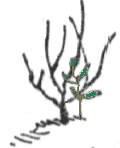 Virtually
all pea plants will require support of some kind, consult the seed
packet to find out their final height. The easiest method of support is to place twigs near the
plants - the tendrils of the plant will twine around the twigs for
support. Thinnings from conifers are ideal - see left diagram.
Virtually
all pea plants will require support of some kind, consult the seed
packet to find out their final height. The easiest method of support is to place twigs near the
plants - the tendrils of the plant will twine around the twigs for
support. Thinnings from conifers are ideal - see left diagram.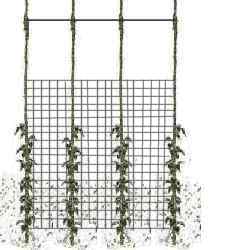 Another
method is to erect canes in a row, tying
in the plants as they grow - netting (available from most garden
centres) tied to the canes will give extra support. The
diagram on the right shows a row of canes secured together with twine
at the top. Each plant is grown up its own individual cane and can
then spread across the netting.
Another
method is to erect canes in a row, tying
in the plants as they grow - netting (available from most garden
centres) tied to the canes will give extra support. The
diagram on the right shows a row of canes secured together with twine
at the top. Each plant is grown up its own individual cane and can
then spread across the netting. 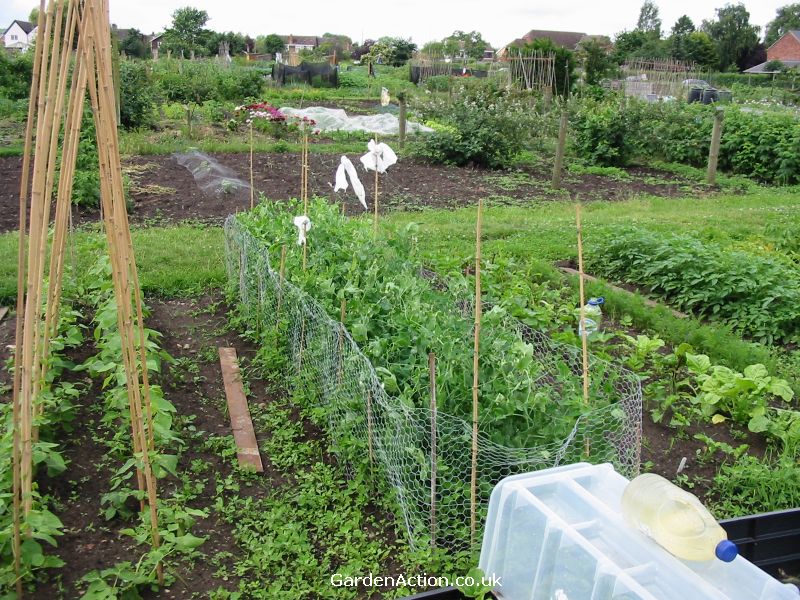 Click the picture on the left to enlarge it and see
exactly what we mean.
Click the picture on the left to enlarge it and see
exactly what we mean.
E-mail: vishalchandran99@gmail.com
Date posted: September 04, 2011 - 01:02 pm
Message: i have a rose plant..quiet big..but there are no flowers...
please tell me what i have to do
E-mail: Qndkness@aol.com
Date posted: August 06, 2011 - 11:11 am
Message: I am a first time gardener and i don't understand alot of the terminology used in gardening. What is a Cloche? What is "pinching off" and how do I do that? Can I plant the seeds in August? I currently have in a small pot some peas, carrots and bok choy seeds planted in a bit of soil. I know that if I want them to grow soon, I will need to move them to the soil. So any and all advice is appreciated. Thanks.
E-mail: o12.crash@juno.com
Date posted: July 05, 2011 - 05:57 pm
Message: I have a couple of pea plant bushes. I have no idea how to plant them and I cant find any website that will tell me. How do I plant a pea bush? HELP!
E-mail: amlotteb@yahoo.com
Date posted: June 24, 2011 - 12:33 pm
Message: This is first time that I have tried growing peas and something is cutting them off about 5 inches off ground. It is a clean cut at an angle. Suggestions??
E-mail: justazad2010@rediffmail.com
Date posted: December 03, 2010 - 03:09 am
Message: Do not west a single " of land.Growing some thing whatever it may be for us or animals.