Categories
Calendars
Guides
Reviews
Archive
Gallery
Articles
Ask Our Gardening Expert
Growing Raspberries

Autumn fruiting varieties produce fruit on branches grown this year,
Pruning of these consists of cutting all growth to 8cm (3in) from the ground each February. Autumn fruiting raspberries are very versatile
because as well as pruning in the traditional manner in
February, you can also have an earlier crop in early summer if
you prune only the top 10 cm (6 in) from some of the canes.
These canes will give a much earlier crop but at the same time
allow the traditionally pruned canes to push through and crop in
autumn. The plants need a ready supply of water to produce good fruits.
Depending on the soil type, watering throughout the summer on a
weekly basis may well be needed. All raspberries will appreciate
a layer of well rotted compost being applied to the soil in
February
each year. Because raspberry roots are very near the
surface, do not dig the compost into the soil, this will only damage
the roots. In the absence of compost, scatter a handful of bone
meal to each square metre (3ft). Raspberry
Picking or Harvesting Raspberries freeze very well. Initially freeze
them spread out on a plate or dish to stop them all freezing
into a mass. When frozen they can be put in plastic bags or
containers and stored in the freezer for a couple of months.
Growing Raspberries
Care
For Your Raspberries
 Summer fruiting raspberry fruits grow from this year's shoots on
last year's branches. The aim of the first year's pruning of
raspberry canes is to encourage the plants to establish a good
root system and prevent them from producing fruits. During June
if any fruits
appear, pinch them off. If you do this, you will not get any
fruit the first summer but the root system will be encouraged to
grow well.
Summer fruiting raspberry fruits grow from this year's shoots on
last year's branches. The aim of the first year's pruning of
raspberry canes is to encourage the plants to establish a good
root system and prevent them from producing fruits. During June
if any fruits
appear, pinch them off. If you do this, you will not get any
fruit the first summer but the root system will be encouraged to
grow well.
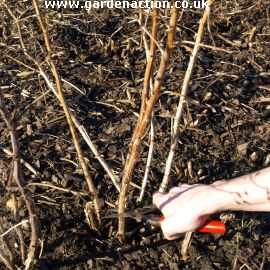 For
summer fruiting raspberries, prune from the second year onwards
by cutting down all of the previous year's branches to 8cm
(3in) from the ground as soon as possible after the fruit has
been harvested, around July time. Any weak looking
new shoots should also be cut down. Tie in the remaining shoots
to the support wires as they grow throughout the summer.
For
summer fruiting raspberries, prune from the second year onwards
by cutting down all of the previous year's branches to 8cm
(3in) from the ground as soon as possible after the fruit has
been harvested, around July time. Any weak looking
new shoots should also be cut down. Tie in the remaining shoots
to the support wires as they grow throughout the summer.
Raspberries which have been picked do not store well at all -
they will only last a day or so. They are also easily damaged
during picking and in storage. The best solution is to pick them
on the day they are required and do not let them be crushed by
their own weight. The fruit does not all ripen at the same time,
so harvesting can take place over several weeks.
Name: Bev
E-mail: the3monroes@yahoo.com
Date posted: July 03, 2011 - 10:34 pm
Message: I have a question......
I bought some marked down plants at walmart, but according to instructions,it is not the right time to plant for Texas how do I store them? or do I just put them in the ground anyway. Thanks for any input.
Name: Deborah
E-mail: clm1963@gmail.com
Date posted: August 09, 2010 - 10:54 am
Message: No advice but rather a question. What advice does anyone have for growing raspberries in South Africa?