Categories
Calendars
Guides
Reviews
Archive
Gallery
Articles
Ask Our Gardening Expert
How to Grow Rosemary
Rosemary is one of the most decorative herbs and is well worth growing for its appearance alone. Dependent on the variety, it has small, profuse flowers appearing in late spring which range from dark blue through pale blue right down to white.

ROSEMARY QUICK GUIDE Rosemary Folklore Latin Name Type Site and Soil Height Plant to Harvest Time
Rosmarinus officinalis
Evergreen, perennial shrub with flowers
Light soil, full sun
Up to 1.8m (6ft) but commonly 1m (3ft)
Nursery plant - 3 months
Cuttings - 1 year
Seed - 15 months
Another great advantage of rosemary is that it is a perennial and will last for twenty years or more with only minimal pruning once a year. Put this together with its cooking value as a herb and this shrub is a winner - what more do you want from a plant!
Although rosemary is a native plant of the Mediterranean and Asia, it is still reasonably hardy in cooler areas. Rosemary is a good choice if you want shrubs that are able to withstand droughts well. It will survive a severe lack of water for lengthy periods of time.
Rosemary has leaves which look like pine needles. It is these needles which can be finely chopped and used to flavour a variety of dishes, especially stuffing. Many cooks simply cut sprigs of rosemary and place many roasted meats, especially lamb, pork, chicken and turkey with great results.
How To Grow Rosemary - Site and Planting
Rosemary prefers a light soil, a sandy soil will fully satisfy its meagre feeding needs. Having said that, rosemary is tolerant of most soil conditions as long as they are not water-logged. Rosemary prefers a slightly limey soil (the opposite of acid) because this results in smaller plants with more fragrant leaves. True to its origins, rosemary prefers sunny and sheltered conditions. It will stand severe frosts if conditions are not windy and wet as well.
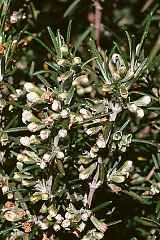
Planting and Care of Rosemary The ideal time to plant out rosemary is April.
Dig a hole in the soil slightly larger than the size as the pot. Add
1cm (half an inch) of sandy soil or sharp sand to the bottom of the
hole. Place the plant in the hole and fill around with a mix of half
sharp sand and half from the removed soil.
Rosemary does not like to have its roots disturbed so leave as much of the root ball undisturbed as possible. Water well if the conditions are at all dry.
Rosemary requires very little care throughout the year. Water only when the compost is clearly dried out and feed once a month with liquid fertiliser from April to October. Trim the side stems to keep the plant to the size you want, the best time to do this is just after they have flowered.
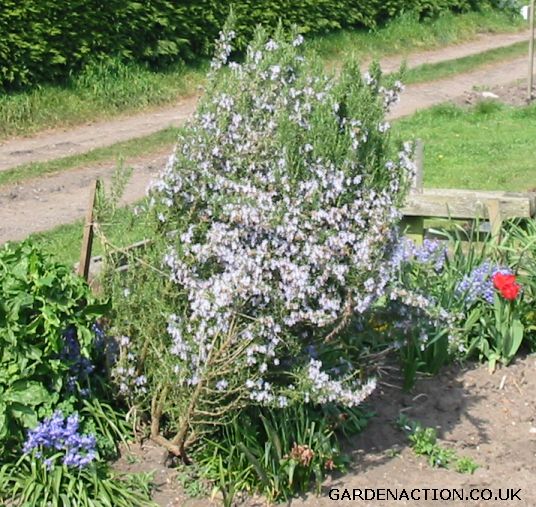
Click the picture to enlarge.
If you like your rosemary plant to grow large and become a specimen plant like the one in the picture on the left then it may need some help from winter winds.
Put a strong stake in the ground near it and tie string round the plant and stake to support it in winter.
How to Grow Rosemary - Propagation
Seeds are readily available from most major seed merchants, although only for Rosmarinus officinalis - we have not seen any seed for sale for the other varieties. The seeds are cheap (click here to buy online), although propagation is erratic. Sow the seeds in potting compost around mid-May time and place in a sheltered position in the garden - unfortunately you will only achieve a success rate of about 15%. The seedlings may well take up to 2 months to appear so don't give up hope until maybe 3 months has past.
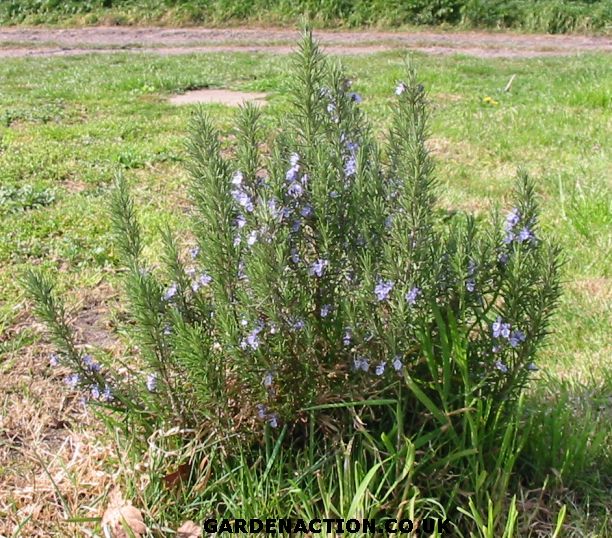
The best method of propagating Rosemary is by taking cuttings, mid-May or June being the best time.
Select a healthy looking plant with lots of new growth on it. Click the picture on the left to enlarge it and see a young, healthy rosemary plant.
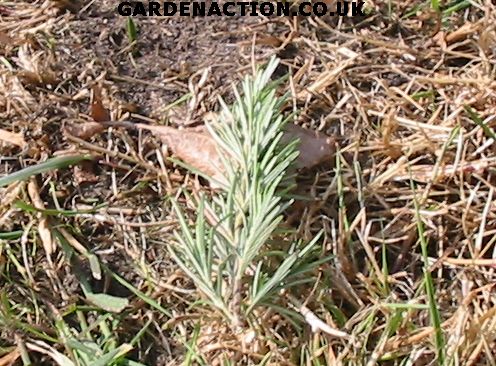
Use a sharp knife to take 7.5cm (3in) cutting from young shoots either just below a leaf joint or torn off at the stem. The picture on the left is a cutting from a healthy shoot.
If tearing off a cutting, trim the "heel" to remove most, but not all of it.
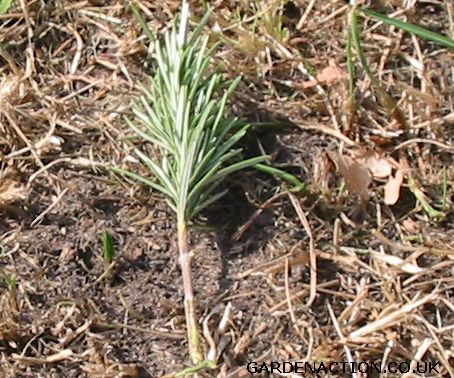
Strip of the leaves from the lower 4cm (1�in), pulling them off with your fingers. Click the picture on the left to enlarge it.
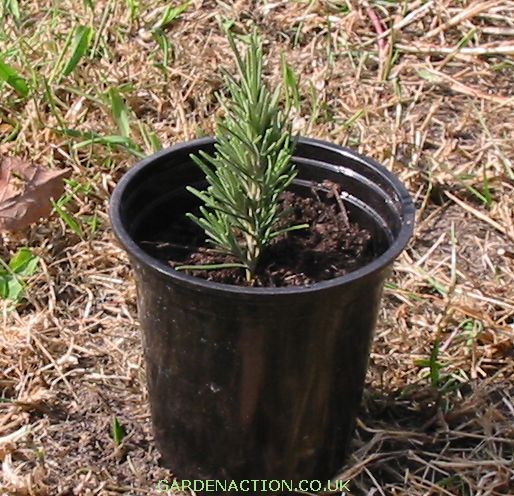
Fill a 7.5cm (3in) pot with standard potting compost and insert one or two cuttings in each pot. Water the compost from below and place in a propagator or cover it with a plastic bag.
A temperature of 15°C to 20°C (60°F to 70°F) is needed for the cuttings to root.
A windowsill out of direct sunlight is an ideal position. They can be transplanted to their permanent position when they have rooted, this will be in roughly 8 weeks time.
Container Growing Rosemary
The herb Rosemary grows extremely well in large pots or other containers. The pots need to be reasonably deep because rosemary is a deep rooting herb. Fill the pot with a mixture of 20% sharp sand or grit and 80% standard potting compost. Make a hole in the compost and place one rooted cutting in the middle of the pot. Water the plant well to help it settle in and consolidate the soil around the roots.
Container grown plants are more likely to affected by severe frosts, so move the containers close to the house walls in winter. For more details on how to grow herbs in containers, click here.
NEXT PAGE ON ROSEMARY
VARIETES
Name: jim@GardenAction
E-mail: webmaster@gardenaction.co.uk
Date posted: December 07, 2011 - 04:08 am
Message: Not sure what the problem could be. Nothing beats plenty of composted material.
Name: Basanta Thapa
E-mail: Private
Date posted: December 07, 2011 - 02:45 am
Message: Dear Sir/Madam
I want to know about gardening process of rosemary plant and also to know advantegeous of this plants.
Name: Lynne
E-mail: breeselynne@hotmail.com
Date posted: December 04, 2011 - 04:53 am
Message: I am having great difficulty growing rosemary. Its a sandy site I suspect that its and old {1950's] dump site as everytime I put my spade in I dig up old iron wear. I have never had a problem with rosemary before ,it has always been a shrub that has thrived on neglect.
Name: jim@GardenAction
E-mail: webmaster@gardenaction.co.uk
Date posted: December 03, 2011 - 10:23 pm
Message: Sometimes you do have to wait for flowering. Buy an older specimen from your nursery. If you shop for wisteria in spring at nurseries you can find wisteria vines already in bloom
Name: Cathy Gontar
E-mail: cgontar@yahoo.com
Date posted: December 03, 2011 - 12:16 pm
Message: I planted a wisteria vine in 2000 and it
is 2011 and has never bloomed. It was supposed to be a white wisteria.
Name: Purna
E-mail: Private
Date posted: September 30, 2011 - 03:53 am
Message: I have got more information about rosemary from your site and I want to know further more information in detail.
Thank you.
Name: halimah
E-mail: halmax07@yahoo.com
Date posted: August 11, 2011 - 07:56 am
Message: i bought a rosemary plant from a garden shop around town.Problem is i transfered it to a bigger can,protected it from direct sunlight but eventually after two weeks it dried up.Am planning to purchase another plant but before i do, i need some advice on how to protect it from drying.hoping to hear from you soon.
Thanx
Name: Abby
E-mail: abbyalden@aol.com
Date posted: August 07, 2011 - 01:44 pm
Message: I need help with rosemary plant if you can?
It sits in a pot on my kitchen window cill in good sunlight. The problem I am having is that it is covered in this white sticky stuff, what I can only describe as 'fluffy'.
Can you tell me what this may be?
How can I treat and stop this? as I want to use the herb, but not sure I should right now.
Many thanks and I hope to hear from you.
Kind regards
Abby Alden
Name: Abby
E-mail: abbyalden@aol.com
Date posted: August 07, 2011 - 01:43 pm
Message: I need help with rosemary plant if you can?
It sits in a pot on my kitchen window cill in good sunlight. The problem I am having is that it is covered in this white sticky stuff, what I can only describe as 'fluffy'.
Can you tell me what this may be?
How can I treat and stop this? as I want to use the herb, but not sure I should right now.
Many thanks and I hope to hear from you.
Kind regards
Abby Alden
Name: davin green
E-mail: davgreen070472@aol.com
Date posted: June 23, 2011 - 07:27 pm
Message: I have a rosemary plant in a large pot in the garden. it gets sun nearly all day and was grown from a sprig purchased from Tesco. I failed to water it for a few days when we had the very dry weather and now all the sprigs are dried out. Is this the end of my well established plant or can it be saved?
Name: alexandra
E-mail: Private
Date posted: May 29, 2011 - 07:59 am
Message: my rosemary plant is turning yellow.it is in a pot,it's 3years old and it gets plenty of sun.nomatter what i've tried i can't seem to save it.any ideas?
Name: cameron sutherland
E-mail: Private
Date posted: January 18, 2011 - 10:44 am
Message: I live in Nashville, tn. I planted a rosemary plant last spring and it tripled in size. It has turned a brownish color. I think it has died from the really cold temps lately.
Do i need to leave it alone, prune it, or will it even come back? Any suggestions?
Name: colin
E-mail: Private
Date posted: January 05, 2011 - 05:33 pm
Message: can rosemary be picked and used for cooking purposes all year round
Name: Bev
E-mail: BevWishart@hotmail.com
Date posted: October 10, 2010 - 07:22 pm
Message: I have had a beautiful rosemary plant outside. I have tied some twine around it and now I'm not sure if I should cover it with a plastic bag and put mulch around the base over the winter. I live in Western British Columbia and it tends to get pretty cold here and lots of snow at times.
Name: rose lynch
E-mail: rmlynch@shaw.ca
Date posted: September 06, 2010 - 02:48 pm
Message: I have a large rosemary plant that is 5 years old. For the last 2 years it has not bloomed. I repotted it last year. Can you advise. Thank you.