Categories
Calendars
Guides
Reviews
Archive
Gallery
Articles
Ask Our Gardening Expert
Growing Chives
Chives
A member of the onion family, chives are well worth cultivating in the vegetable and
flower garden. They take up very little space, and the whole plant can be eaten from
top to bottom.

QUICK GUIDE TO CHIVES Folklore Latin Name Type Site and Soil Plant to Harvest Time
Click here
Allium schoenoprasum
Edible flowering herb from the onion family.
Most soils, partial shade or full sun.
3 months
If the flower heads are not removed, they are ideal as a decorative edging to a flower border with freely produced purple flowers.
A less common variety is Chinese chive which has a delicate hint of garlic in the leaves - these too produce flowers although not so many - they are white and appear in late summer.
Where To Grow Chives
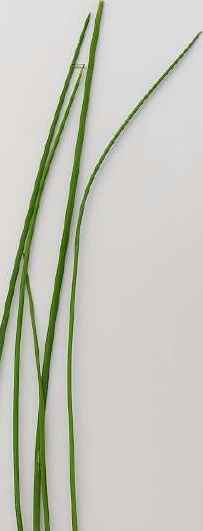 Chives will grow in almost all soils, the ideal one being well-dug with
the addition of well-rotted compost or organic material. Work in a
handful or two of bonemeal per square metre (yard). Chives are not
greedy feeders, so it is not necessary to feed throughout the year if
the soil has been prepared as described.
Chives will grow in almost all soils, the ideal one being well-dug with
the addition of well-rotted compost or organic material. Work in a
handful or two of bonemeal per square metre (yard). Chives are not
greedy feeders, so it is not necessary to feed throughout the year if
the soil has been prepared as described.
Full sun or partial shade suit them equally well, and although they are fairly tolerant of drought, don't plant them in very dry places.
Propagating Chives
Chives are very similar to onions, they have a bulbous root and green
leaves. The bulbs multiply quickly over a few years and this provides
the easiest method of propagation. Simply dig up the clump of bulbs in
March
or
October, carefully separate them into individual bulbs and
replant with the tips of the bulbs level with the soil surface. They
thrive on this method of propagation, because it relieves the congestion in the bulbs.
Growing chives from seed is almost as easy - sow the seeds indoors using normal potting compost in March time (or directly outside in April) . Make sure the compost remains moist. The seedlings will appear a week to ten days later. Transfer them outside a month after sowing with 10cm (8in) between each plant.
Care of Chives
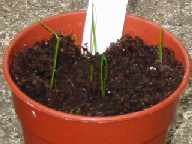
Chive seedlings soon after germination
This is simple! If the soil has been prepared as described above,
just sit back and watch them grow! They are almost completely free of
disease, and their only requirement is watering if the conditions become
very dry. They occasionally suffer from onion fly, but this is almost
always because they have been planted near onions which have been
attacked - the solution is not to plant chives near onions.
Chives are perennial evergreen plants, and keep their leaves in most winters. In colder winters, the leaves may die back completely, but don't despair - their roots are still alive and they will begin new growth next spring.
Name: jim@GardenAction
E-mail: webmaster@gardenaction.co.uk
Date posted: November 15, 2011 - 08:12 pm
Message: Parsley and chives take time, wait a bit longer.
Name: Marjan
E-mail: marjankrivograd@yahoo.com.au
Date posted: November 15, 2011 - 06:39 pm
Message: I plant my parsley and cnives 2 week ago in my pot ,and they didn't come out of soil yet.How long is take to see them to come out .
Name: Neil
E-mail: Private
Date posted: November 02, 2011 - 05:08 am
Message: Good info many thanks. Will return to site.
Name: Nicole
E-mail: Private
Date posted: June 19, 2011 - 05:59 pm
Message: I need to know how long does it take to grow a chive plant? *in detail* (how long in like time)
Name: Tob
E-mail: halloweenblessed@yahoo.co.jp
Date posted: May 15, 2011 - 02:45 am
Message: hi
In my back garden in west London, i have a few chive plants, obviously planted by one of my previous home owners. Besides them, there are also plants of a chive-like species, which grow a cluster of white flowers shaped into a half sphere, not a ball of violet flowers. Please advise they are also a variant of chive.
Name: neil kanhai
E-mail: neil _kanhai@hotmail.com
Date posted: May 13, 2011 - 12:17 pm
Message: please send me some booklets at grant trace ext ragoo gardens beaucarro trinidad w i
Name: george holtkamp
E-mail: gholtkamp@hotmail.com
Date posted: May 05, 2011 - 09:23 pm
Message: have always grown chives successfully, but of late am having no luck, they turn brown and wilt, and thats that. l live in Hervey Bay, Qld. We have had huge amounts of rain for so long,maybe thats why!
Name: Alan Turner
E-mail: alan_turner@fsmail.net
Date posted: January 23, 2011 - 05:31 am
Message: I recently bought a pot of chives from a supermarket and they were all standing straight. Within a few days most lent over. Is this normal and if not how do I correct it?
Regards AT.
Name: James Post
E-mail: Private
Date posted: January 18, 2011 - 11:19 am
Message: Hi De,
I live in Grenada and are preparing to start a small scale organic vegetable garden. Over here they usually sell the chives including bulb.
It seems to be that it is more economical to cut them close to the soil as I assume that they will regrow faster that way. Am I correct?
Thanks,
James
Name: DeAnna
E-mail: de-miller@live.com
Date posted: November 21, 2010 - 01:44 pm
Message: i love growing and eating chives,i have had great luck doing it...