Categories
Calendars
Guides
Reviews
Archive
Gallery
Articles
Ask Our Gardening Expert
Potato Pest and Disease(continued - page 3)
How To Harvest and Store Potatoes Remove any soil clinging to the potatoes and leave them on the soil for a few
hours to dry out - if they are stored damp, they will rot. Leaving them
on the soil surface in the sun will harden the skin slightly, doubling
the storage time - this is especially important for maincrop potatoes. Store the
potatoes in boxes or sacks, checking them every few days, removing all
but those in good condition. Damaged or blemished potatoes should be eaten immediately. One word of caution, some potato flowers may well turn to berries which are
definitely poisonous. Eaten in sufficient amounts the berries can be
fatal. You may wish to remove them if children are likely to see them. Other
Methods of Growing Potatoes The second method is to cover the planting area for early varieties with
black polythene, simply held down with earth or bricks. The
potatoes are planted at normal depth by cutting a '+' shaped hole in
the plastic and planting with a trowel. The advantages are that the soil
is warmed by the black polythene, giving the young plants protection
from frost. The potatoes should be ready for harvest a couple of weeks earlier than normal. Pests and Diseases Potato blight has two phases - the first attacks the leaves, the second attacks
the potatoes themselves. If your potatoes are attacked by the blight,
there is no cure. However, cut the foliage back to 5cm (2in) from the
ground at the first signs of infection. This will prevent the blight
from getting to the potatoes themselves. With no foliage, the potatoes
will not give of their best, but they will continue to grow for a month or so.
For more information on potato blight go to our dedicated potato blight
page by clicking here. Name: james gallagher Name: shirley rainey Name: C Sinclair Name: C Sinclair Name: Ruth Vickery Name: Carol Down Name: gordon shaw Name: Tony Barratt Name: darrell marsh Name: Judy Name: sandy west Name: helen whyte Name: Janet Name: Eric Douthit Name: spencer burrows Name: rick edney Name: Jacqui Name: steve and maddy kavanagh Name: Jan 
Potato Pest and Disease
(continued - page 3)
Potatoes are ready for harvest when the foliage first starts to die and turn
yellow. Early (new) potatoes can be lifted earlier (no earlier than
June
) to
get the very tastiest potatoes. In this case, harvest them about a week
after the potato plant flowers first appear. New potatoes only produce a
couple of handfuls of potatoes per plant, so dig up the whole plant.
 Maincrop
potatoes will be ready for harvest in mid-Autumn (start of
September
at the earliest). For
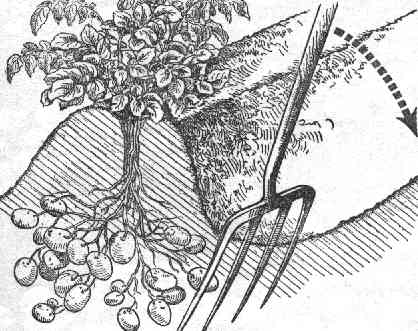
all potatoes, dig them up from the side of the ridge (a fork or
spade are both fine) to avoid damaging the potatoes. See the diagram on
the left (click to enlarge).
The foliage can be placed on the compost heap only if it completely free
from disease - if not, burn it. If you don't need all the potatoes from
a plant at one time or if you want a few early in the season, simply burrow around
the roots with your hands and remove the potatoes you need. The remaining potatoes will continue to grow.
Maincrop
potatoes will be ready for harvest in mid-Autumn (start of
September
at the earliest). For
all potatoes, dig them up from the side of the ridge (a fork or
spade are both fine) to avoid damaging the potatoes. See the diagram on
the left (click to enlarge).
The foliage can be placed on the compost heap only if it completely free
from disease - if not, burn it. If you don't need all the potatoes from
a plant at one time or if you want a few early in the season, simply burrow around
the roots with your hands and remove the potatoes you need. The remaining potatoes will continue to grow.
There are two common alternate methods of growing potatoes by the
amateur gardener. The first is container growing. This can produce a
surprisingly amount of potatoes and is great for very small gardens.
Click here for our step by
step guide with pictures on how to grow potatoes in containers and pots.
Potatoes grown from stock certified as free from disease and planted in
soil not occupied by potatoes the previous season, are relatively free
from pests and diseases. The most common ailments to affect potatoes are
potato blight (see next paragraph), scab, slugs, and wireworm. There is little protection
available that can effectively solve these problems.
E-mail: allagher@clfs.surrey.sch.uk
Date posted: September 20, 2011 - 10:57 am
Message: my spuds do not seem to be growing, can anyone help
E-mail: duckonhat@shaw.ca
Date posted: August 06, 2011 - 09:47 pm
Message: MY POTATOES HAVE NO BLOSSOMS.SHOULD I WORRY.SHIRLEY
E-mail: nessfarm@btinternet.com
Date posted: July 23, 2011 - 02:12 pm
Message: I would like to know what makes potato tubers split while still growing
E-mail: nessfarm@btinternet.com
Date posted: July 23, 2011 - 02:10 pm
Message: I would like to know what makes potato tubers while still in the ground
E-mail: rooey100@googlemail.com
Date posted: July 18, 2011 - 12:31 pm
Message: Can anyone help with the mysterious buds I have growing on my potato plates please. They look like, what I can only describe as vine tomatoes. The buds are solid, and green. I can not find any information on what they are, if they are normal or what to do with them. Has anyone come across this before? Oh and I have no idea what type of potato they are either. Thank you for your help in advance.
E-mail: Private
Date posted: July 13, 2011 - 12:24 pm
Message: some potatos appear to have beetroot colored flesh! any ideas anyone?
E-mail: gordonshaw99@aol.com
Date posted: July 04, 2011 - 06:43 am
Message: after potatoes started flowering in two beds, within a couple of weeks the petals have fallen off most of the plants which seems too quick. other plants are in full bloom and show no signs of the petals falling off.any suggestions as to why the petals have fallen off so early?
E-mail: Private
Date posted: June 27, 2011 - 02:29 am
Message: Sandy, It sounds like you have scab on your spuds. Its purely cosmetic and won't affect the potato. Just peel it off before or after cooking.
E-mail: orca2@charter.net
Date posted: June 17, 2011 - 04:48 pm
Message: i just started growing potatoes in late may and it is growing leavesalready. how will i lnow if they are full grown and ready to pick. this is my first time growing potatoes and i am excited about it.
E-mail: Private
Date posted: June 16, 2011 - 07:54 am
Message: Hi.
My problem is the same as Helen White (june 13th 2011)
My potatoes are grown in large pots and have black spots on the leaves. The leaves are not curling. Do I dig them up or leave them?
Please can you advise me on what to do.
Thanks Judy
E-mail: Private
Date posted: June 15, 2011 - 10:33 am
Message: Some of the potatoes that I've dug up have what appears as warts all over them, & some potatoes are fine, what could be making them have those ugly warts
E-mail: Private
Date posted: June 13, 2011 - 02:28 pm
Message: my potatoes growing in bags have developed black spots on the leaves, what is the cause of this and what can i do to help??
E-mail: Private
Date posted: June 04, 2011 - 02:45 am
Message: Help! I'm harvesting Charlotte potatoes from the container they're growing in, most are fine, but 2 or 3 have turned in to a wet soggy puddle! The rest of the soil feels v dry, till i come across a liquified potato, urgh! Is this what happens to the seed potato once it's finished producing new potatoes? I don't think it's blight as the leaves are fine. Should I dig them all up ASAP, or can I leave some & pick as required still? Any advice would be gratefully received! Thanks, Janet
E-mail: ericdouhtit@yahoo.com
Date posted: May 26, 2011 - 10:53 am
Message: Ive got 3 rows of potatoes about 35 ft. Three diff. kinds. The first 2 rows were planted about 2 weeks before the last. They have been in the ground since late feb. My prob. is the leaves are getting black spots then yellowing only on the first 2 rows. They were bought at the same place and the 3rd. row looks awesome. I sprayed all of them with malathion (it was all i had). Does this sound like a bug or disease and what should i do? Panicing! Please e-mail I would greatly appreciate it.
E-mail: spencerburrows@live.com
Date posted: May 24, 2011 - 06:21 pm
Message: When can i pull my new potatoes up? They are grown in tubs. Some flowered over 2weeks ago.
E-mail: rick.edney@btinternet.com
Date posted: May 23, 2011 - 01:25 pm
Message: I have just come back from holiday and found some of my 1st and 2nd early potatoes flattened by rain or wind. Some of the plants have no top growth at all. Do I harvest them now or leave them until the other plants are ready ?
E-mail: nannyjac5@hotmail.co.uk
Date posted: May 15, 2011 - 11:37 am
Message: Hi, first time growing potatoes and have earthed them up twice as instructed. The green tops won't stop growing and must be approx 18" plus above the chit potatoe. When should I stop earthing up? Thank you
E-mail: Private
Date posted: December 26, 2010 - 06:25 pm
Message: i would like to know how to grow potatoes at home
E-mail: Private
Date posted: November 14, 2010 - 11:23 am
Message: I plantes late potatoes in growing bags. There are no potatoes at the tnd of any of the planys - whats gone wrong please