Categories
Calendars
Guides
Reviews
Archive
Gallery
Articles
Ask Our Gardening Expert
This is something the most amateur gardener
can do with success. It's also an excellent way of growing
potatoes in a small space. What You Will Need
2.
Enough multi-purpose compost to nearly fill the
container.
3.
Between one and three seed potatoes (see main
article below), preferably sprouted.
4.
Concentrated liquid tomato feed for use later
in the season
When to Plant Seed Potatoes in a Container The Container
Any size of container can be used from 30cm (1 ft) wide and deep up
to a full-sized dustbin. They can be rigid plastic, plastic sheet
(as above), dustbins, almost anything. The only requirement is that they
have good drainage holes in the bottom.
Fill the bottom of the container with about 10cm (4in) of
multipurpose compost. As you add it to the container, break up
any lumps. This will allow the potatoes to grow more easily and
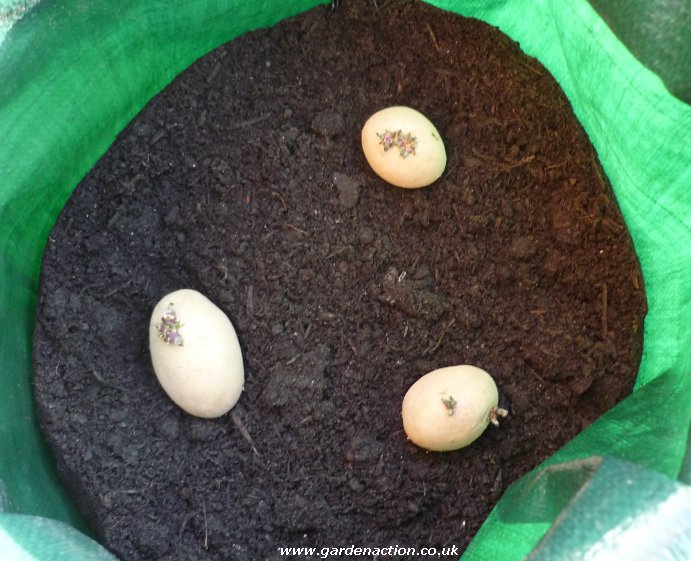
bulk out the compost. Place the seed potatoes on the top of
the compost with the side that has the most sprouted eyes
uppermost.
Water the
container well and then mark it up with the variety of potato
being grown. Place the container in a light and airy position out of any
chance of frost.
After a few weeks shoots will begin to appear from the
compost. When they reach about 15cm (6in) above the soil level,
add about 10cm (4in) more multipurpose compost so that only 5cm
(2in) of the shoot is above soil level. Repeat the above
process until the shoots reach above the top of the container. Care of Potatoes While Growing If the potato plants start to produce flowers then pinch
these off to encourage the plant to produce larger potatoes and not
seed. Harvesting The Potatoes
Potatoes are ready for harvest when the foliage starts to
turn yellow. Maincrop potatoes especially can be left in the
compost for several weeks longer. Early potatoes can be
harvested before the leaves turn yellow for small tasty new
potatoes. Sometime in early June, carefully feel through the
soil to judge the size of the potatoes with your hands. Harvest
the by twisting and pulling gently. The remaining potatoes will
continue to grow.
Because the potatoes are grown in a container of fresh
multipurpose they are very unlikely to be affected by any soil
borne pests and diseases. The only care they require is earthing
up a few times and to be kept watered and fed. Our step
by step guide takes you through the process with pictures.
 1.
A container to grow the potatoes in (see main
article below).
1.
A container to grow the potatoes in (see main
article below).
The average time for planting potatoes in the open ground in the UK
is around mid-March, a few weeks later in colder areas, a few weeks
earlier in warmer areas. When you grow potatoes in containers you can
plant them a few weeks earlier as long as you make sure they are in a
relatively warm position. For example, near the side of a house wall out
of strong winds is a good position.
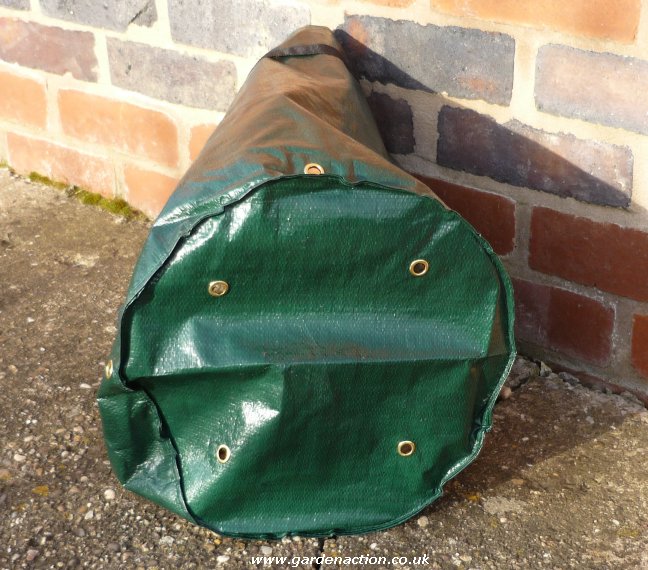
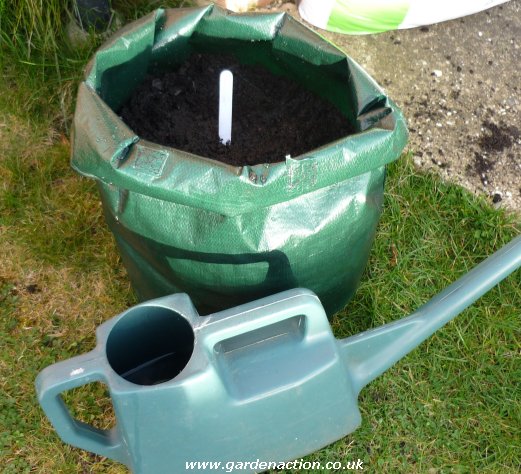
We used a reinforced plastic container specially designed for growing
potatoes in. From experience we know these will last several years.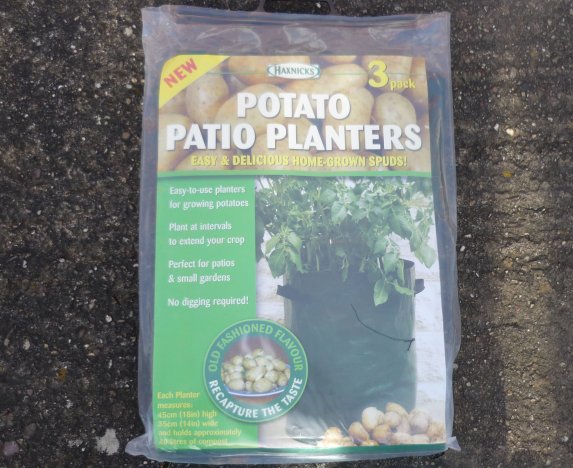
The Seed Potatoes
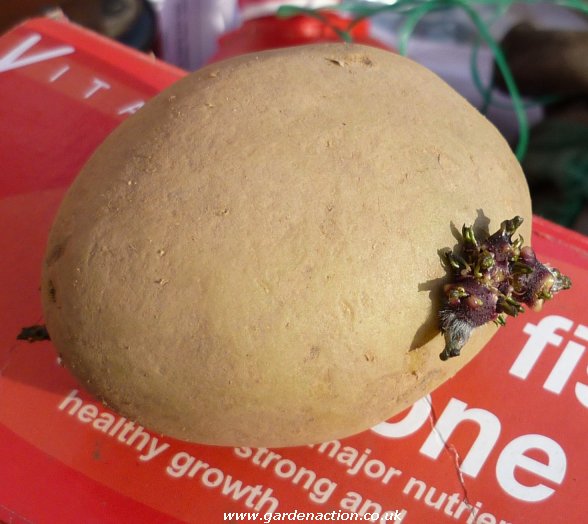 The seed potato on the left has been chitted or sprouted.
Click
here to go to the main potato article for more details
on this process. Chitting is not necessary but it will give an
earlier crop of potatoes.
The seed potato on the left has been chitted or sprouted.
Click
here to go to the main potato article for more details
on this process. Chitting is not necessary but it will give an
earlier crop of potatoes.
Depending on the size of the container you will need between one
and three seed potatoes. For a 30cm (1ft) container use 1 seed
potato. For larger containers use two to three seed potatoes.
Don't use more than three.
Planting the Seed Potatoes
Complete the Planting
 With the seed potatoes in place add another 10cm (4in) of
multipurpose, breaking down any lumps as you go.
With the seed potatoes in place add another 10cm (4in) of
multipurpose, breaking down any lumps as you go.
Earthing Up the Potatoes
The main care required is watering and feeding. Water when the compost
starts to dry out. Check it by uncovering 10cm (4in) or so of compost
and checking if it is drying out. The weight of the container will also
indicte if the compost is drying out. Feed every couple weeks with a
concentrated tomato feed, diluted as per the instructions on the packet.
Name: Dee Long
E-mail: Private
Date posted: August 22, 2011 - 08:04 pm
Message: I planted just the eyes of a potato with just a little meat of the the potato. They are have grown approximately 6" high can I transplant them in the ground? and how soon?
Name: gill
E-mail: g11drn@hotmail.co.uk
Date posted: July 31, 2011 - 10:01 am
Message: i've got my potatoes in very large pots,i got great foliage,but no flowers,now foliage starting to turn yellow,will i have potatoes if i dig them up.?? im an amatuer is u can no doubt tell!
Name: carole
E-mail: Private
Date posted: July 24, 2011 - 05:16 pm
Message: My cabbages are growing well but they are starting to have tiny holes in the leaves! I have checked them for butterfly eggs and caterpillers. I dont want to use anything harsh on them what do you suggest please?
Name: francis
E-mail: subscription11@hotmail.co.uk
Date posted: July 22, 2011 - 07:54 am
Message: i am growing potatoes in bagas and tubs they have been growing well have been in for approx. 10 weeks should the foliage be so tall as its falling over and breaking unable to keep upright iff so is it ok or have i done some thing wrong. foliage about 1 meter tall
Name: John
E-mail: john.baxter67@btinternet.com
Date posted: June 18, 2011 - 12:10 am
Message: I have 3 large tubs and have followed instructions to the letter. I have sewn the seed potatoes which have grown well and built up the compost levels as directed. The plants are now easily 18 inches tall. I sewed them in March, now mid June, I keep a lookout for flowers. None so far but where I expect to see a flower, there are tiny buds that seem to be eaten off or "clipped" (not by me). I have all new compost in my tubs but have not fed them with any tomato food as suggested. Is it too late to do this? No yellowing of leaves as yet. I am reluctant to disturb them incase the potatoes (if any) are not formed yet but I think the only way is to go ahead and have a peek I think. Perhaps I should wait until the leaves start to die down and turn yellow. I have just read that not all potatoes produce a flower, this is somewhat disconcerting!
Name: Mary
E-mail: Private
Date posted: May 22, 2011 - 04:04 am
Message: My garden isn't very big so i've grown mine in ikea bags this year and they are doing really well
Name: Annette
E-mail: Private
Date posted: May 19, 2011 - 09:31 am
Message: I am new to potato growing I have planted them in large pots I have had a feel round and I don't think I have any pototoes growing although the plant looks well and has started flowering I have planted earlies .
Name: sharon
E-mail: Private
Date posted: May 12, 2011 - 12:18 pm
Message: my potatoes are growing in 3" by 2ft wood box is that enought room & when the stem turn yellow is it time to cut them back? what is the best time to plant and how long can u harvest them? p.s. i started growing them from a potatoes full of eyes. thank you
Name: f cotsford
E-mail: frederick@cotsford1066.plus.com
Date posted: May 04, 2011 - 04:23 am
Message: my potatoes in a dust bin had great top growth but no potatoes under neath
Name: Marcy
E-mail: mttxtiger@yahoo.com
Date posted: May 03, 2011 - 04:10 pm
Message: I got a half bag of Idaho potatoes that have eyes all over them. I cut them up, put toothpicks in them and placed them on top of water jars so they will sprout and grow stems. I have seen this done a long time ago, so I am trying this with these potatoes that have eyes all over them. I have about 24 jars of them. I would like to plant them into containers with compost, to raise the compost level as the stem grows taller. I want to watch and see what happens. I have not grown potatoes before. I just learned that it will take four months from planting to harvest, and to keep the soil moist, with good drainage. I will put dried leaves instead of straw around them to keep the grass weeds out, because this is what I have. I wantt to plant some in a raised bed and watch which method gives better results.
Name: Sara Maskell
E-mail: Private
Date posted: September 05, 2010 - 04:42 pm
Message: Brian, mine have purple flowers and are Maris Piper :)
Name: sarah marshall
E-mail: harroldmentor@yahoo.co.uk
Date posted: August 24, 2010 - 08:13 am
Message: I would like to plant potatoes ready to harvest for xmas. Is this possible? What variety and technique do i need to use - I am an amateur!!!! But do have raised beds
Name: Brian
E-mail: bchicadonna@aol.com
Date posted: August 13, 2010 - 05:46 pm
Message: A Friend has Spuds in pots in her garden
they are starting to bllom the flowers are a purple colour can you tell us the variaty as she cant member what they were
thank you