Categories
Calendars
Guides
Reviews
Archive
Gallery
Articles
Ask Our Gardening Expert
Bramley's Seedling Cooking Apple

Bramley's Seedling
Cooking Apple
The Bramley Apple tree rightly has a
unique place in the history of UK apple tree cultivation. It produces the best
cooking apple of all and the British cannot understand why the Bramley apple is not
more frequently cultivated abroad.
In 1809 (the bicentenary of the Bramley
occurs in 2009) Mary Ann Brailsford planted some pips in her garden in Church
Street, Southwell, Nottingham. Where she sourced the pips from is a mystery. In 1846
she sold the house, with the apple trees still growing strongly, to a butcher named
Matthew Bramley. In 1856 the apple tree came to the
attention of a local entrepreneur and nurseryman, Mr Henry Merryweather. Matthew
Bramley agreed to let Henry Merryweather cultivate and sell the apple trees on the
condition that that they were named after him. The Bramley apple tree was about to
explode into the British apple tree market. In 1900 a severe storm blew down the
original Bramley apple tree in Church Street. With careful attention however it was
restored to health and still bears apples to this day. If you want to buy Bramley's Seedling
(Bramley) from our
recommended suppliers, then
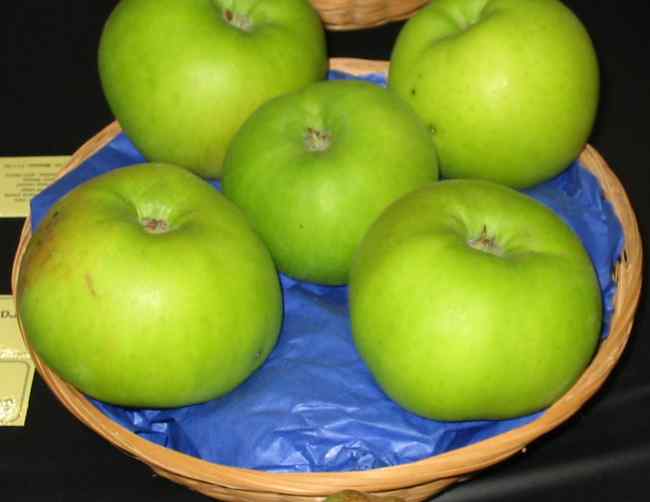
click here. The fruit has a smooth green skin with
some red, and the apples are larger than normal. The taste is decidedly acidic
making them ideal for cooking. Possibly their only failing is that they do not
retain their shape when cooked as well as some other varieties. However, for some
this is not a failing because the cooked fruit has a very agreeable smooth texture.
The apple trees are
triploid and partially self-fertile. The fruit will keep well into the spring. If you visit Southwell, Nottingham in
October, watch out for the annual Bramley Apple festival. It celebrates everything
to do with this most famous of cooking apples.
THE APPLE
Taste
Sharp and juicy. Ideal for cooking.
Skin Texture
Medium thick
Flesh
White, goes to a puree on cooking.
Apple size
Large
GROWING
Flower period
Middle season
Pollination Group
3 (triploid)
Vigour
A strong growing tree
Crop Yield
High
Eating
time
October to early March
Tree
Shape
Upright
then spreads

Name: Geoff Stebbens
E-mail: Private
Date posted: August 15, 2010 - 07:20 am
Message: Herllo,
Is it essential to have a polinator for Bramleys or will there be some success without one/two?
What soil preparation is ideal before planting out?
Many Thanks
Geoff Stebbens