Categories
Calendars
Guides
Reviews
Archive
Gallery
Articles
Ask Our Gardening Expert
Autumn Top Job Bulb Selection and Planting

GARDENACTION Top Job
How To Choose The Best Bulbs Select bulbs which are undamaged and plump, the larger the bulb the better the resulting plant. Bulb Planting As a general rule, plant bulbs to a depth of at least twice their size. For
the more common bulbs and their planting depth, click here. Bulb planting in a flower bed consists of digging over the soil to a spade's
depth, incorporating some bonemeal or other long lasting fertiliser,
then planting the bulbs at the correct depth. For a good display, plant
the bulbs apart at roughly the same distance as the planting depth. For naturalising in a lawn, mark an area roughly 3 foot square, and skim of
the top turf with a spade. Fork over the soil, incorporating a long
lasting fertiliser (for example bonemeal). Plant the bulbs to the
correct depth (and the same distance apart). replace the soil and turf
and firm it down. If the conditions are dry, apply some water, but do not water-log the bulbs.
Crown Imperials The bulbs have hollow crowns that will hold water and cause rotting, so
plant them on their sides. They should be left in the same place for
four or five years. On heavy soils, plant them in coarse sand or grit to improve drainage. Scented Bulbs
Autumn Top Job
Bulb Selection and Planting
The majority of Spring flowering bulbs can be planted in September, the principal
exception being tulips which should be planted in late October or November. For a full
list of bulb planting and flowering times, click here.
As soon as the bulbs are purchased, store them in cool place if not planting
immediately. Daffodils and erythronium in particular deteriorate out of
the ground, so plant as soon as possible.
These beautiful fritillarias need a little special attention. They
should be planted to a depth of 6in / 15cm in a dryish soil - crown imperials will not thrive in wet soil. 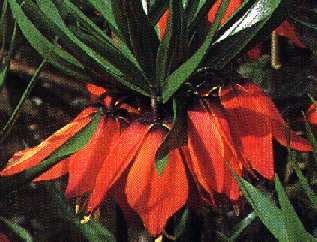
Crown Imperial
The supreme scented bulb is the hyacinth, followed closely by some of the lilies -
lilium regale and lilium auratum are particularly good. A few daffodils
are scented, notably Narcissus 'Albus Plenus Odoratus' and Narcissus poeticus.