Categories
Calendars
Guides
Reviews
Archive
Gallery
Articles
Ask Our Gardening Expert





Greenhouse Watering
TOPICS IN SELECTING EQUIPMENT FOR
YOUR GARDEN GREENHOUSE
Below we
describe the equipment available and their advantages and disadvantages. There is a bewildering array of watering cans on the market and many
simply do not do the job as well as the best. A watering can will be used
for watering plants and accuracy is important for this. They will also be
used to apply nutrients and sometimes other chemicals such as weed
killers where accuracy is even more important.
When buying a watering can remember that they can last literally
decades, so buy the best one you can afford that does the job you want.
Capacity of the watering
can is important. To avoid constant refilling of a watering can, buy the
biggest size that you think you can comfortably carry. Watering cans of 6
litre capacity are fine for most men, though women may find these too
heavy when completely full. Make sure the rose (where the water comes
out) is brass. Plastic ones will deform in heat or cold leaving you with
a watering can which dribbles! When buying a watering can remember that they can last literally
decades, so buy the best one you can afford that does the job you want. Click here for a range of professional watering cans that do the job well and
efficiently. These systems rely on gravity or electricity to deliver water in
controlled amounts to individual plant pots. These systems can supply
water (or water with liquid feed in it) to many plant pots at the same
time. They are great timesavers and can also be used to automatically
water plants when you are not at home. Click here for a range of automatic watering systems from our recommended suppliers. This system of watering is covered in another section of our site but we
repeat it here because it is probably the cheapest method of automatic
watering. It is also surprisingly accurate given its simplicity. Again,
this system is good for saving time and for watering plants automatically
when you are not at home. A special purpose greenhouse staging, called a capillary bench, is also
widely available. This bench has a surface with edges raised a couple of
inches (5cm). The surface is lined with capillary matting which goes over
the side of the bench into a vat of water. The capillary matting will
suck up the water and remain damp at all times. Pots placed on the
surface of the capillary matting will then suck up the water and remain
automatically watered. This is very useful at any time of the year because the potted plants
will remain evenly watered. It is especially useful if you plan to leave
the plants uncared for whilst you go on holidays. Add some liquid
fertiliser to the water vat and the plants will be automatically
fed and watered. You will need a level bench, some plastic sheeting to protect the bench
and capillary matting to transfer the water and feed to your plants. A
reservoir of water is also required. Simply lay the plastic on the bench,
then cover with capillary matting. One end of the mat should be placed in
the water reservoir. Then place the plants firmly on the capillary
matting and they will draw the water from the reservoir, through the
matting and into the soil. Click here if you wish to buy capillary matting equipment online
from our recommended suppliers for this equipment.
Watering and Feeding in Your Greenhouse
Water and a supply of nutrients are essential in all greenhouses big
or small. The range of equipment spans the simple watering can filled
from a tap with liquid feed added manually, right up to automatic
watering kits which can run by themselves for up to 40 days. GREENHOUSE WATERING - WATERING CANS
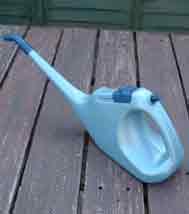 Capacity of the watering
can is important. To avoid constant refilling of a watering can, buy the
biggest size that you think you can comfortably carry. Watering cans of 6
litre capacity are fine for most men, though women may find these too
heavy when completely full. Make sure the rose (where the water comes
out) is brass. Plastic ones will deform in heat or cold leaving you with
a watering can which dribbles!
Capacity of the watering
can is important. To avoid constant refilling of a watering can, buy the
biggest size that you think you can comfortably carry. Watering cans of 6
litre capacity are fine for most men, though women may find these too
heavy when completely full. Make sure the rose (where the water comes
out) is brass. Plastic ones will deform in heat or cold leaving you with
a watering can which dribbles!
GREENHOUSE WATERING - AUTOMATIC SYSTEMS
GREENHOUSE WATERING - CAPILLARY MATTING
