Categories
Calendars
Guides
Reviews
Archive
Gallery
Articles
Ask Our Gardening Expert





Greenhouse Select A Site
TOPICS IN SELECTING A SITE FOR
YOUR GARDEN GREENHOUSE
Is Shelter Necessary? Shelter can be provided by a several means, a building, trees and a
hedge are the normal methods. There are two main considerations when
selecting the site for your garden greenhouse with an eye to protecting it from
high winds. These are the height of wind barrier and how close it is will
be to the greenhouse.
The previous section of this article on light illustrates how much
shade is cast by a hedge or building. It is a trade off sometimes between
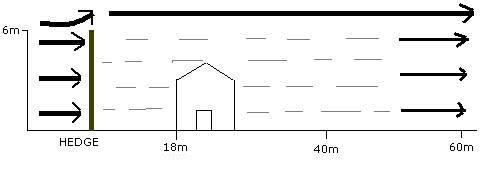
casting a shadow and protecting the greenhouse from wind. The diagram
below illustrates that a hedge will, on average, provide an effective
windbreak for around ten times it's height. This is a much greater
distance than any shadow it will cast, even in winter. If you are designing a garden which is liable to strong
winds, the best protection is not a solid structure such as a wall or
wooden fence. These cause the air striking them to be deflected above the
fence at speed, only to descend at a short distance later. The best
structure for wind protection is a windbreak such as a hedge. A hedge will let around 50% of the air pass through it,
slowing it's speed as it does so. The remaining air will be more
gradually deflected upwards and will not reach it's previous speed until
a good 10 or 12 times the height of the hedge later. A hedge used as a windbreak needs three key qualities: 1. The correct density of foliage and branches Hedges which fit these criteria include Privet, Yew,
Holly, and many of the Conifers. These hedges will need regular cutting
to avoid them becoming too tall and therefore casting too much shade.
Shelter from strong winds may well not be necessary in your garden. If
this is the case, click on 'Other Factors' in the bar above or select
another topic from the bookmarks at the top of the page.
2. The ability to survive well in windy conditions
3. Be evergreen in order to provide winter protection
