Categories
Calendars
Guides
Reviews
Archive
Gallery
Articles
Ask Our Gardening Expert





Garden Greenhouse Selection
TOPICS IN SELECTING GREENHOUSES
Greenhouse Shape? They offer different combinations of affordability,
running costs, good light transmission and practicality. Each greenhouse
shape is
considered below in detail.
Lean-To Greenhouses Traditional Shaped Greenhouse Even with the traditional garden greenhouse shape, there are subtle
variations and they generally arise in order to maximise light
transmission in the winter and spring months. At these times of year, you
may well be growing plants in your greenhouse, and maximum light
transmission is important because the sun is so low in the sky and days
are generally more cloudy. Light transmission is not so important in
the summer months because there is more than enough light to go round. When thinking about light transmission, the obvious needs to be
mentioned! There is only one sun and it shines on your greenhouse from
roughly the same direction each winter and spring day. The point in
maximising light transmission is to provide light to all parts of the
greenhouse and not just the side facing the sun. There are four main variations on the traditional shaped greenhouse,
each is a compromise as shown below.
However, the angle of the sun on the sides of the greenhouse is
roughly an 80 degree angle which means a lot of light is absorbed
and reflected round the greenhouse.
The roof is very similar to the greenhouse above which causes
much of the light to bounce off. Overall, a very good shape.
The walls are as per the standard greenhouse shape.
The shorter base wall is as per the traditional greenhouse.
Unfortunately this type of greenhouse is expensive to manufacture.
The positioning of a greenhouse is also a key factor for maximum light
transmission. All traditional type greenhouses should be positioned such
that their longest side runs east to west to allow maximum light
transmission in darker months. Octagonal Shaped Greenhouse Another advantage (although at considerable cost) is that the circular
benching which can be bought for them gives a large and convenient area
for potting up plants and growing them on. One possible disadvantage of an octagonal greenhouse is that
ventilation during the hot summer months is difficult. There are always
pockets of heat which develop because of the round shape. Lots of opening
ventilation windows are required to ensure an even temperature during the
summer.
There are three main shapes for garden greenhouses. Traditional,
octagonal and the lean-to greenhouses. Other shapes are available but
they are normally a combination of the above three shapes.
Click here to go to our lean-to
greenhouse page. Lots of information about the types available and their benefits.
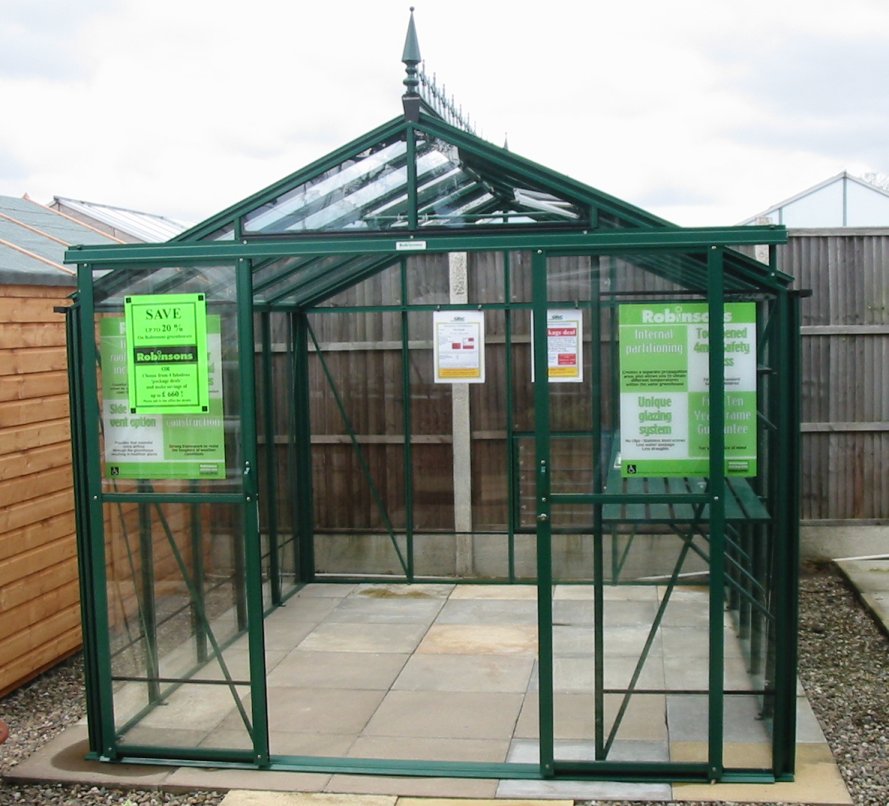 One key advantage of the traditional shaped greenhouse is that there are
far more sizes available than other types, they are generally cheaper to
buy and they are available from a large number of suppliers. So, if this
greenhouse shape matches your needs, buy it rather than the more
expensive octagonal or lean-to greenhouses.
One key advantage of the traditional shaped greenhouse is that there are
far more sizes available than other types, they are generally cheaper to
buy and they are available from a large number of suppliers. So, if this
greenhouse shape matches your needs, buy it rather than the more
expensive octagonal or lean-to greenhouses.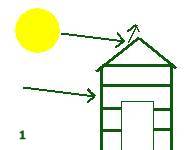
The standard greenhouse shape. With the sun low in
the sky during winter and early spring, much of the light bounces
off the roof because it is not at the ideal angle of 90 degrees.
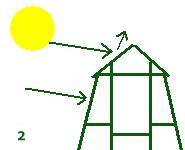
This is the basic greenhouse shape but the side
walls are leaning in. This means that the angle of the sun against
the side walls is very close to a perfect 90 degrees.
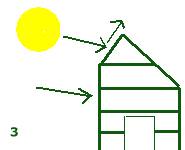
An unusual variant on the standard greenhouse, but
some companies do sell this type of greenhouse. The greenhouse
must be positioned so that the short steeper side of the roof
faces the sun. The sun-facing side of the roof presents an angle
nearer to 90 degrees to the sun than all the other
greenhouses.
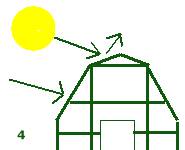
Probably the best compromise, this greenhouse has a
very small roof area which reflects light out of the greenhouse.
The long middle side wall is at an ideal 90 degrees to the
sun.
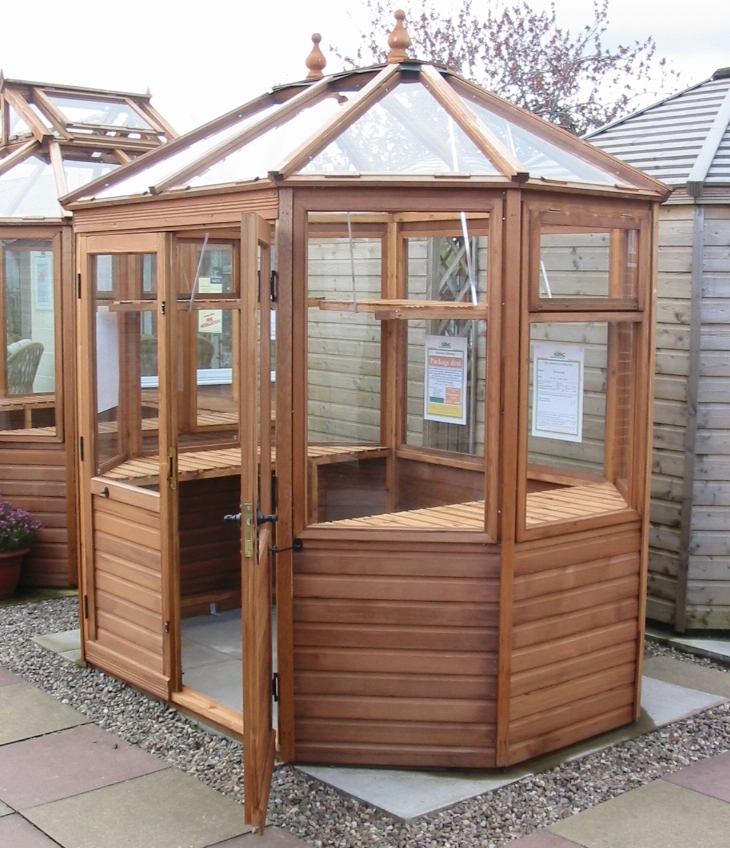 These do tend to be the most expensive greenhouses, but their shape makes
them an attractive feature in many gardens. In addition, their shape
ensures there is always part of the greenhouse at any time which is at
the ideal angle of 90 degrees to the sun.
These do tend to be the most expensive greenhouses, but their shape makes
them an attractive feature in many gardens. In addition, their shape
ensures there is always part of the greenhouse at any time which is at
the ideal angle of 90 degrees to the sun.
